
April 11, 2012
Being Aristoi
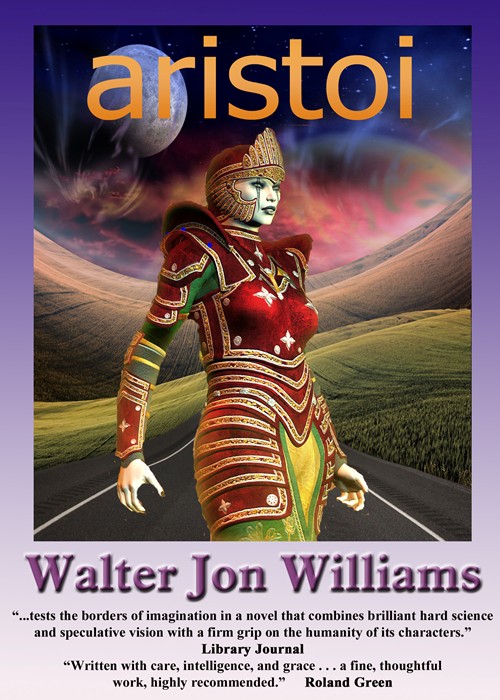 When I wrote Aristoi I damn near had to teach myself to write all over again. The book was just that different.
When I started writing science fiction, I believe in late 1983, I came up with a list of what I wanted to do. Because I’d come from a fairly limited branch of historical fiction— naval action-adventure, where every plot concerned about 200 males on a ship— I wanted to expand in as many directions as possible.
So here is my list:
-
The future where everything went right. (This became my novel Knight Moves.)
-
The future where everything went wrong. (Hardwired)
-
A mystery/thriller (Voice of the Whirlwind)
-
A first-contact novel (Angel Station)
-
A comedy (The Crown Jewels)
-
A hard-boiled mystery (Days of Atonement)
In an extremely creative period of maybe three of four months in 1983, I conceived of and at least lightly plotted each of these works. Which, as I wrote them, led to a certain amount of anxiety. I was coming to the end of my list. What would I write next? What if I’d burned myself out creatively back in 1984?
I began making another list, this one of ideas and concepts that I’d never written about before. And then I jammed them all together in one incredibly detailed piece of worldbuilding.
One book was a primary influence in the worldbuilding: Francis Fukuyama’s The End of History, which offered the hypothesis that, following the collapse of the Eastern Bloc, the world was going to consist of parliamentary social democracies— social democracies all the way down, as it were.
Snort, I snorted. I can think of all sorts of ways that autocracies will not only survive, but thrive. So I decided to write about a society in which the rulers were more absolute even than Louis XIV. And it was a good thing.
I wanted to write about nanotechnology, which I had only touched on in previous works. I wanted to write about virtual reality in a more comprehensive way than I’d seen in the past. I wanted to write about ideas about the mind/body interface that I’d developed through studying martial arts, and how it might be altered through implant wetware. And I wanted to write about multiple personalities.
Now I had met a couple people who suffered from what was then called Multiple Personality Disorder (a term no longer in use). And I began to realize that it’s not just Walt Whitman who contains multitudes, we all have different personalities and voices in our heads. When I was with my friends, my personality was different than when I was with my parents, which was different from my personality in the karate school. The personalities that I adopt in this blog, and when speaking on panels at science fiction conventions, are to a degree constructs. The difference between me and someone with MPD is that I have someone in charge. I have a governing me who decides which personality to employ in any given situation. What’s happening in the head of someone with MPD is something more akin to anarchy.
I realized that all these voices are, to a great extent, useful— at least so long as someone’s in charge— and that if you empowered these personalities, you could multitask like a sonofabitch.
I worked out the world of Aristoi in immense detail while I was writing books like Angel Station and Days of Atonement. Because it was an aristocratic society, with an elite in charge, the world of the Aristoi would share features with other conservative societies. There would be an appeal to tradition and to the past. Hence the characters are always quoting classical poetry or thinkers of the past in order to buttress their arguments. They use classical languages, like ancient Greek (because I’d studied Greek) and Chinese (because it’s the oldest surviving culture around, and I’m very interested in China.)
There would be a fairly rigid social order, with the Aristoi (“the Best”) on top, in the middle the Therápontes (“Servants”— which is also what “Samurai” means, by the way), and the Demos— the People— at the bottom of the pyramid.
I realized that the only way to construct such a radically different society would be in reaction to severe trauma— in this case, the destruction of Earth by runaway technology. Society has developed technology so dangerous that only a small class of people can be allowed to wield it.
But how do you choose such people? A problem with conservative societies throughout history is how they pass on wealth and power— through heredity. As Charlie Stross recently remarked on his blog, a society ruled by a monarch has a single point of failure. If you inherit the job and you’re not up to it, or if you’re simply evil, then your society has little recourse. They can overthrow you and replace you with another king, but who’s to say that king is any better? Or that his offspring will be?
So in Aristoi, social barriers are not absolute— it’s a aristocratic meritocracy, in which absolute rulers are chosen through a series of examinations, like mandarins in Confucian China. Through application, genius, talent, and drive, a member of the Demos can become an Aristos.
What are these exams like? I elided over them for the most part, but I assumed that much of the exams would consists of psychological profiling to make certain that any candidates are stable enough to be trusted with absolute power.
Born in tragedy, the Aristoi strive above all to create a society that’s safe. There’s no war, there’s no poverty (unless it’s self-inflicted), there’s very little violence. All children are planned, wanted, and loved. Education is there to take you as far as you care to go. Life extension technology is available that will allow people to live for hundreds of years. Though each Ariste is absolute within her own domaine, the borders are porous enough that people can leave if their lives become too oppressive. You don’t want to run a domaine in which all the smart, talented people are leaving. (Your peers will smirk and write satires, and you can’t have that.)
Having worked out my world in some detail, I then set myself to figuring out my point-of-view character. He would be an Aristos, a sort of self-made prince. I made him aesthetic, because that would enable him to experience his own world in all its rich detail. I gave him lots of different and contrasting voices in his head, some of whom were female and lusted after men. (I have no personal experience with bisexuality, but I figured what the hell, I have a good imagination.)
So what does being an Aristos do to you once you’re elevated to that office? The exams have supposedly ensured that you’re not going to break down into a crazed, paranoid mess, or charge off to eliminate all gingers from the gene pool; but on the other hand you still wield absolute power, and everyone around you is always agreeing with you. So you’re going to be a little bit smug, and you’re probably going to have lots of sex with pretty much anyone you want.
(Readers who object to Gabriel on the grounds that he’s conceited have never asked themselves what they would be like if they’d never met an obstacle they couldn’t overcome, a test they couldn’t pass, or a person they couldn’t sleep with.)
Frequent readers of this blog may note that Aristoi was created the wrong way ’round. In the past, my books each started with a character I wanted to write about, and I built the world and the plot around that character. Now, I created the world first, and then the character. But what of the plot?
Plot stopped me for a long time. I couldn’t think of a story that would— that could— take place in this dazzling world. Things seemed too stable, too perfect. Whatever crisis arose, the Aristoi would simply deal with it.
The answer came while I was sitting on a panel at a science fiction convention. I sat next to Gene Wolfe; and while he was talking, the entire plot of Aristoi unfolded inside my head.
What was Gene talking about? I have no idea. It had nothing to do with plots or my novel, of that I’m sure. I believe it was a panel on workshops.
Just sitting within the aura of one of our field’s authentic geniuses seems to have done the trick. (Thanks, Gene!)
So I was able to put a proposal together, and sell it to Tor. And then I wrote it.
I decided that I was really going to pull out all the stops. I was going to make every scene a tour-de-force. I was going to show that, by Jove, I belonged in this goddam field, and that I belonged at the top of it.
Reading Aristoi now for the first time since I sent in page proofs in 1991, what strikes me the most is its absolutely demented ambition. This ambition shows up even in the typography, where I sometimes broke the narrative into two columns, the first describing the action, and the second describing a conversation among the voices in Gabriel’s head.
(This, by the way, is a fairly literal description of the sorts of dialogs that go on in my own head. When I’m engaged in mock and semi-mock combat at my kenpo school, I have whole parliaments in my head chattering about what to do next, and what to watch out for, and how to resolve tactical problems. Those scenes in Aristoi aren’t fanciful at all.)
I just loved writing this book. It just poured onto the page in all its operatic detail.
What I ended up writing was something that is now called New Space Opera. Except that I’m not British, so I’m not allowed to write New Space Opera, so we have to find another name for it.
Aristoi. A garden of unearthly delights, insane ambition, and absolute power. Now available as an ebook for Kindle, Nook, and via Smashwords.
Reader responses
Comments
Be the first to respond.