
October 24, 2012
Cat Island
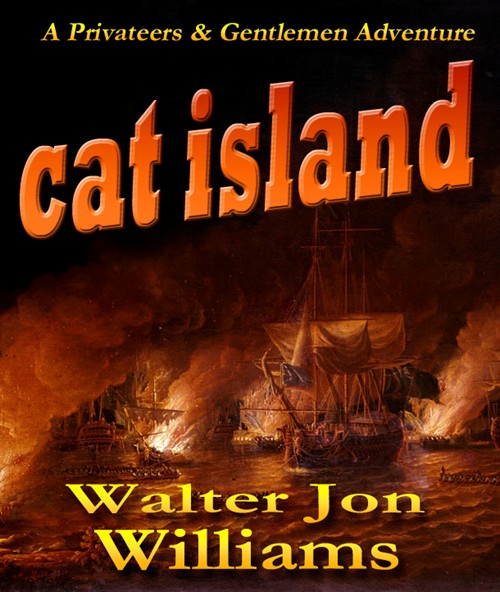 I am pleased to report that Cat Island, my long out-of-print sea-adventure tale, is now available via Amazon, Barnes & Noble, and Smashwords.
Cat Island is the final volume in a sort of inadvertent trilogy. I had planned to write only one novel about Favian Markham— in the outline, my story was neat and tidy— but then once I started writing it, it kept sprawling. I found a natural place to end Brig of War, and figured the rest would fit a single volume, but I spent most of The Macedonian just getting my hero to sea, so I split the book in two and sent my hero to New Orleans in the last volume.
There is a kind of Platonic ideal to a certain kind of adventure-romance, and it runs something like action-sex-action-sex-action. Five big scenes, and you’re out. Plus of course the action and sex can be leavened by, say, intrigue or character development or historical trivia or anything else, so long as it won’t send the reader to sleep.
If you take The Macedonian and Cat Island as a unified whole, it follows the Platonic ideal well enough. But if you take Cat Island as a single work, it’s weighted on either end. It sort of runs intrigue-sex-intrigue-sex-intrigue-sex-action-action-action-action-action. In the original paperback, the final action scenes run something like 120 pages. (They aren’t nonstop— there are character and plot moments in there— but there are an awful lot of cannon being fired in those pages.)
The book takes place in and around New Orleans, which was fascinating in 1814 and is fascinating now. It was the only city in the United States where Anglo-Saxons and Protestants were a minority. There were French Creoles and Spanish Creoles and even Irish and German Creoles, there were veterans of the Napoleonic Wars and the French Revolution, there were Choctaws, there were Free Men of Color, and all of the above had slaves who spoke their own creole languages. There were refugees from French colonies that had been taken by the British, as well as refugees from the successful rebellion in Haiti. The first Mississippi steamboat had arrived only a couple years before, and it was the steamboats who opened New Orleans to America, and vice versa— but in 1814, New Orleans was an island surrounded by water, and very much a place unto itself.
The outlines of the Big Easy to come were not difficult to discern. Creole culture was exotic and vibrant, but it was based on a brutal exploitation of an underclass that provided the Creoles the leisure to indulge themselves. Then, as now, there was a huge party vibe. Corruption was ubiquitous, since the Creoles saw no reason why they should pay customs duties to a remote government, nor obey the laws that forbade the importation of slaves. Jean and Pierre Laffite smuggled slaves and goods almost openly, and dealt with the governor and legislature as equals. (At one point, when Governor Claiborne offered a $500 reward for Laffite’s capture, Laffite offered a $50,000 reward for Claiborne! Claiborne was lucky no one tried to collect.)
The Creoles were united in resisting the incursions of the “Kaintucks,” as the Americans were called, but they were themselves strongly divided into factions. As well, they had an absolute mania for dueling, and fought each other on the drop of a pretext. Anyone carrying a sword was assumed to be looking for a fight, and would probably be obliged… as a result, the gentlemen carried sword canes, and fought with those.
Would the Creoles find the United States of America worth fighting for? Or would they prefer to reach an accommodation with the British? That was a very serious question in December of 1814.
Among the skills of the English nation in this period was the ability to read maps. They saw that down the Mississippi came the produce of the Ohio, the Tennessee, the Cumberland, the Missouri, and the entire Midwest. If they could seize New Orleans, the British could control the fate of the American West: they could kill American expansion dead simply by raising tariffs on American production. (This was part of a larger strategy of encirclement that involved forts on the Canadian frontier, support for Tecumseh’s Indian empire in the West, and support as well for the Creeks in the South.)
The New Orleans expedition was probably the largest expeditionary force sent by the British in the entire war— over 150 ships. (Nelson at Trafalgar had only twenty-seven.) There were 8000 British troops, with another 8000 waiting in Europe as a second wave. Commanding was Ned Pakenham, Wellington’s brother-in-law— certainly the best general available, since Wellington didn’t want to go himself.
As I mentioned, New Orleans was almost literally an island, surrounded on all sides by water. The British fleet ruled the waves, but could it also rule the lakes, rivers, and bayous that led to the city? They had maps, but the maps were less than useful, so they tried to hire Jean Laffite as a guide. Laffite preferred the American regime under which he was making a lot of cash to any theoretical dominion of the British— and besides, the U.S. Navy put his Barataria colony out of commission and captured all his ships.
It was Andrew Jackson who made the difference. On his way to New Orleans he captured Pensacola (which, despite being Spanish, was then occupied by the British). He captured Pensacola on November 8, driving out the British and Creeks, then returned the town to the Spanish governor on November 9, after which Jackson marched for Mobile, arriving on the 19th. Up till then he’d been assuming the British were after Mobile— they’d made a try back in September— but on hearing word that they were aimed at New Orleans, he marched for the city. He arrived with an advanced party on December 2, and the rest of his army arrived on December 23, the very day that the British advanced guard came out of the swamps below the town. (Apparently it was possible to march in army from Mobile to the Mississippi, though it took a month.)
Jackson attacked instantly and so savagely that the British decided to wait for reinforcements, and after that the campaign took on the characteristics of a siege. There was not a single Battle of New Orleans, but five— that first encounter on the 23rd, an assault on Jackson’s fortified lines a few days later, a bombardment in mid-January, and then the grand assault that cost General Pakenham his life. In the meantime, the British fleet was bombarding Fort St. Philip below the city. The British lost every one of the five engagements.
Cat Island emphasizes the nautical aspects of the campaign, which tend to be glossed over by histories. I also report, pretty accurately, all the scheming and conflicts among New Orleans’ various factions, including the Laffites, and of course Andrew Jackson, who stunned not only the British with his ferocity, but his own side.
This was the fifth book written in the series, and by this point the epic had attracted a rather large cast. Lots of minor characters had to be seen to, and Favian’s story wound up. (And happily, by the way— my cynical, dyspeptic hero finds himself disarmed by a most unlikely romance.) There is a rather shocking development at the very end, which was designed to explain why part of the Markham family ended up in the South— I was setting up the Civil War books that would follow, and which I never got to write.
This is the first of my homespun ebooks in which I did significant rewriting— as I mentioned in an earlier post, I cut away a lot of the expository prose with which my younger self had lumbered the book. So now you can get straight into the intrigue-sex-intrigue-sex etc., and brace yourself for the colossal action finale.
This isn’t at all a bad book to end the series on. I wrap up everything that needs wrapping up, and I make Favian earn every ounce of the happiness I give him at the end.
By all means enjoy.
Reader responses
Comments
Be the first to respond.