
September 20, 2015
Dragging It Out
Dish Network gave me a free premium channel the other week, and so I watched The Hunger Games: Mockingjay, Part I. Which was a kind of masterpiece, because in a film over two hours long nothing really happened.
 What’s going on is that the success of the Twilight films, in which the final volume of the trilogy was broken up into two separate films, has created a new paradigm— Two movies! Twice the money!
I haven’t read the book on which the film was based, and so I don’t know how closely the action in the movie parallels the action in the book, but in any case practically none of it was necessary action.
At the beginning, Katniss has been rescued from the latest iteration of the Hunger Games and brought to the Sekrit Underground Base of the rebels, which is so well-equipped with amazing technology that I was astounded these guys were on the losing side of the last war. Once safe underground, Katniss faces the same challenge to her integrity that she faced in the first film.
In Hunger Games, Katniss had to suppress her genuinely heroic personality in order to become a teevee action star, because being a teevee action star was the only way to inspire the Capitol’s decadent aristos to help her in the Games. In Mockingjay, she finds herself a symbol in a nationwide rebellion against Evil President Snow, and so Possibly-Not-As-Evil rebel President Coin wants her to suppress her genuinely heroic personality and become a star of propaganda videos. Everyone wants Katniss to become a complete phony, and we all know how much teens hate that.
And then tension ratchets up, and things get worse for a long time. But while there are lots of incidents, including an actual save-the-cat moment, plus lots of battles and explosions, lots of chances for President Snow to be Evil, lots of pictures of ruins, and many challenges to Katniss’s character, the plot itself doesn’t move. At the end, Katniss is in exactly the same place she was at the start, and so is the rebellion. The only thing that happens is that Peeta is rescued, and that could have been pushed to the next film.
The film was a brilliant triumph of incident over plot. If enough things happen, the creators seem to say, the audience won’t notice that nothing changes.
I’ve been noticing this a lot lately, especially in the superhero genre. This summer I’ve been watching The Flash, which has excellent production values, an attractive young cast, and a whole lot of well-done soap opera. But most of the episodes feature a plot with a lot of vamping.
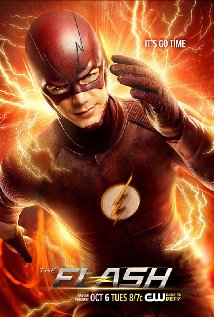 And the reason is that the Flash’s super-speed, if treated honestly, will solve just about every problem in, well, the blink of an eye. He can run just short of the speed of sound, say 700mph, and that means that he can grab every villain in Central City, disarm them, drop each in his very own cell, and pick up all the bubble gum from the streets, all in the amount of time it takes me to walk from my easy chair to the refrigerator.
So in every episode, the Flash has to stop to talk to the villains, or do some other stupid dang thing, so that the villains can defeat him or put him in jeopardy or shoot him with their freeze ray. The action is a complete stall until the climactic scene, when the Flash remembers— Hey, I’ve got super-speed!— and then he whisks the villains off to justice.
For instance, when confronted by a nearly invulnerable super-bruiser, the Flash tries to fight him with his fists, so of course the super-bruiser whomps the tar out of him. (Fortunately the Flash also has super-healing.) What the Flash needed to do was not accelerate his fists, but objects.
A small lead ball accelerated to 700mph becomes a bullet, and it is deadly. A six-pound cannonball accelerated to 700mph will punch a hole in a wall. A titanium rod accelerated to 700mph can punch through a tank.
As I remember the episode, the Flash eventually defeated the super-bruiser by bashing him repeatedly with a flagpole, a job that involved jeopardy and a lot of effort. Whereas if he had just tucked the flagpole under his arm and used it as a 700mph lance, he would have run the guy through in no time. (Now maybe the Flash doesn’t want to kill someone that way, which I respect. In which case he should just start hurling large steel ball bearings at the guy’s knees.)
In a recent episode, the Flash was trapped in an office building by a swarm of bees. (Bees? Seriously?) All the dude needed was a flyswatter or a rolled-up newspaper– flappity-flappity, and the bees are all dead. Or he could have clapped his hands and knocked them from the sky with the sonic boom. Or any number of things.
Amazingly enough in a series with a cast composed mainly of scientists, nobody thinks of Newton’s Second Law: f=ma.
(The Flash is also into good deeds, like rescuing small children from being run over by large semi trucks. But what happens to a child accelerated in an instant from zero to 700mph? I’m guessing acute organ displacement.)
Fortunately the season’s villain seems to be the Anti-Flash, a bad guy with the Flash’s own powers, so the Flash has an opponent who can actually challenge him. (Besides his own lack of imagination, that is.)
Reading a lot of recent fiction, I’ve noticed a great many books in which the middle third exists only for the purpose of postponing the finale. If you’re a writer, you should aspire to more than that. Don’t just throw in meaningless incidents, or create phony dilemmas. Reveal character! Create subplots that resonate with the main plot! Create characters whose problems reflect on those of the protagonist! Catch the antagonist in a revealing moment! There’s a lot you can do.
Go forth, O Writer, and do it.
Reader responses
Comments
Be the first to respond.