
June 7, 2012
Fahrenheit Zero
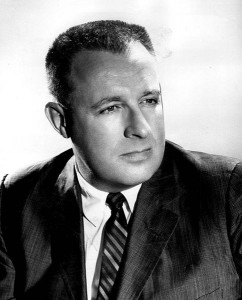 I found a picture of Ray Bradbury as he looked before he became the affable, bespectacled, white-haired figure we’ve seen over the last couple decades. This is a lot closer to how he looked when he wrote the stories and novels for which he’ll most likely be remembered.
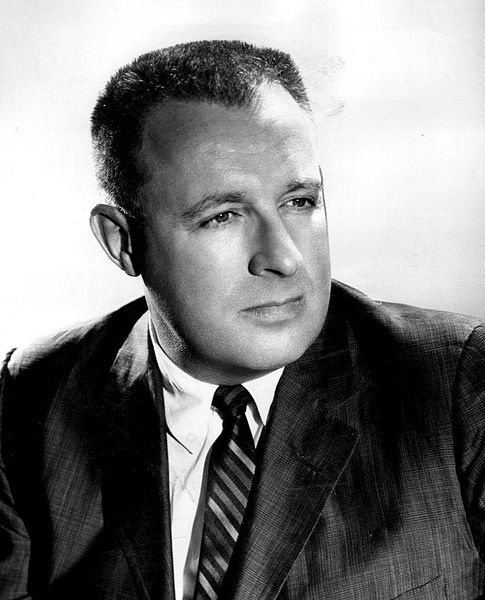
He looks serious, driven. He looks like he’s taking dead aim at something. Most likely he’ll hit it.
He also looks like someone who’s at home in a feud. My understanding is that this was pretty much the case.
I’ve been several times in the same room with Mr. Bradbury, but he was always surrounded by old friends and I never wanted to intrude. I remember once that he showed up to an event in shorts and knee socks— maybe he’d bicycled there— and I remember looking at his plump, pink knees.
I never knew him. But I hear from those who knew him that he was a delightful, loving human being, and that his passing has left a great, weeping hole in the heart of the world. I’m inclined to believe them.
Fortunately for us, he left his books behind.
I’d like to make only one observation, which was that Bradbury was in no way a snob. He wasn’t the sort of science fiction snob who wrote only inside the bubble of pulp SF, or who disdained mundane readers. He wanted the broadest audience possible, and so (like Heinlein) he wrote for the Saturday Evening Post. He wrote stories for Madamoiselle (where his editor was a young Truman Capote). He wrote scripts for Twilight Zone and Alfred Hitchcock Presents.
When Bradbury began to develop a reputation as a literary writer, he didn’t become a literary snob, either. (“If I’d found out that Norman Mailer liked me,” he said, “I’d have killed myself.”) His reading was eclectic, he never went to college, he never lost his enthusiasm. He never stopped writing about the things that moved him.
He didn’t bother doing the math. He wasn’t interested in how rocket ships were built or propelled or how they got to Mars. He was interested in what human beings did once they got out of their rockets and set foot on an alien world.
For this reason, his stories don’t date themselves in the same way that, say, Heinlein’s stories are dated. Once Heinlein’s characters whip out their slipsticks to check the computer’s binary calculations as they’re spat out on a paper tape, you can only sigh. Bradbury wasn’t interested in those sorts of calculations. He wouldn’t tell you how a rocket worked: he’d tell you how it felt to work one.
Another reason Bradbury’s stories don’t date is that he built the nostalgia right into them. They’re about a world that’s already gone past. His Mars rockets are twinkly and old-fashioned now, but they were also twinkly and old-fashioned in 1945. He was all about lost worlds, and when you read the stories you see the loss everywhere.
Bradbury wrote that it was a chance encounter with a carnival performer called Mr. Electrico that made him a writer. No one else seems to remember Mr. Electrico, and no one has ever managed to confirm the story. But the story is, by God, vintage Bradbury, and if it isn’t true it should be.
So now I’ll repeat what Mr. Electrico said to the young Ray Bradbury as he knighted him with his sizzling electric sword:
“Live forever.”
Reader responses
Comments
Be the first to respond.