
June 2, 2015
Family
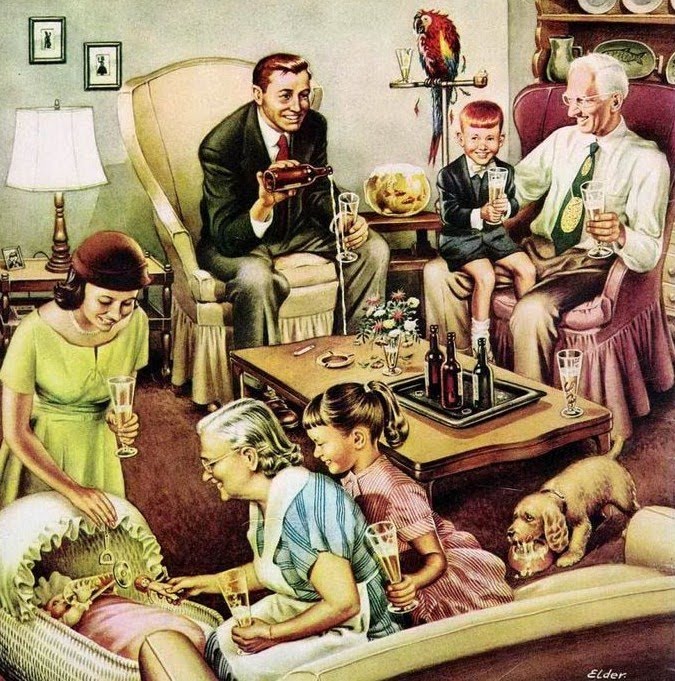 So what good is family, exactly?
Raising children, obviously, and caring for the elderly; establishing a financial and property arrangement to the benefit of all members; providing emotional support, a loving and safe environment; a sensible division of labor. All of which is to some degree supported and regulated by law.
But what’s the point of family in fiction?
Well, you could be writing a novel about family, in which case a family should be right there center stage. But families in family novels are rarely models of their kind. Because fiction thrives on conflict, the only reason to write a novel about a family is when the family goes wrong. Anna Karenina wouldn’t have been much of a novel if Anna had rejected Vronsky and stayed with her husband. She still might have thrown herself under a train at the end, but it would have been out of boredom, not despair.
Though of course the family could be okay, while everything else goes to hell. The Joads seemed reasonably functional until they got caught in the Dust Bowl and were evicted from their homes, after which they understandably went downhill.
But what about family in genre fiction? Protagonists in genre often have no family at all, in part because it makes it easier to have adventures. If you’re busy saving the world/galaxy/ President/whatever, you don’t want to be bothered with those three o’clock feedings. And if you’re the heroine of a romance novel, kids and a husband hanging around might just spoil the Happily Ever After with your new beau.
Natty Bumppo was pretty much on his own. Sherlock Holmes had a brother he met maybe twice in his adult life, but was otherwise free of relationships. Nero Wolfe, Sam Spade, Philip Marlowe, and Miss Marple were all single. (Though Marlowe did manage to get married in the penultimate Marlowe novel, after which his creator never finished more than a few pages of the next. Maybe the challenge of writing a domesticated Marlowe was too great).
Action heroes are traditionally single, which allows a possible romantic relationship to develop during the narrative. A surprising number of heroes are chaste, but then a life composed entirely of pursuing villains, or being pursued by them, doesn’t leave a lot of time even for speed dating.
Of course genre writers observed that people do, in fact, have families, and eventually set out to provide their characters with some. So Tarzan got Jane, and John Carter got Dejah Thoris, Kimball Kinnison got Clarissa MacDougal, and Lazarus Long set up housekeeping with his mother.
So now it’s not unusual for a protagonist to have settled down with someone, or have somewhere in her past a mysterious divorce with its hint of broken hearts and tragedy, or to have had (or adopted) children. It makes for a more well-rounded protagonist, provides someone for the character to talk to, and gives the hero someone and something to come home to.
But so far as I can tell, the actual functional purpose of having family in genre fiction is so that they can be kidnaped and held hostage.
Let’s face it, Jane and Dejah Thoris got kidnapped a lot. It was almost their full-time job. (Though, being self-sufficient, swashbuckling Burroughs females, they generally rescued themselves long before Tarzan or John Carter turned up.)
Series fiction seems particularly prone to hostage-taking. Several volumes into the work, the writer’s original inspiration has long gone, and there are more books to go on the contract, and the writer by then has taken some pains to establish the protagonist’s family. If the writer can’t figure out any better way to motivate his hero, maybe having a daughter being kidnaped will get the character out of his easy chair and into action.
Sons, I observe, never seem to get kidnaped. In the last few months I’ve read no less than five novels in which daughters were held hostage— I’ve even complained about it— but I can’t think of any works in which male offspring are carried off. There’s a higher squick factor with girls, because of the implied threat of rape . . . of course boys can get raped, too, but genre fiction seems unwilling to explore that possibility.
Threatening the family is all a way to make things personal for the hero, but in these stories the heroes (who in all these examples are male) seems to have plenty of warning, all of which is ignored. If a threat to the family is supposed to galvanize the hero, it seems in practice to do the opposite. The heroes are complacent where their families are concerned, almost supine, and usually fail to take even the most elementary precautions.
In fact once people in your family start getting taken hostage, the hostage crises start coming thick and fast. In the book I’m reading now, the detective remarks to his daughter, “I don’t know if you remember that case of the missing estate agent.”
The daughter’s proper reply would have been, “You mean the case where I was kidnaped and held hostage?” but she never says it, because she seems to have forgotten all that, too— and the author was probably hoping the readers would forget as well, because it’s clear she’s about to be kidnaped all over again.
(I should point out that, in one of my works where I gave the protagonist a family, it took only one family member being killed for Loren to take measures to protect the rest. Other writers should feel free to profit from this example.)
While the heroes seem unable to prevent their daughters from being carried away, once it happens they seem to go completely unhinged. They insist on charging into the situation alone, acting independently, without backup— even though in most cases they are officers of the law, and can theoretically bring the entire power and resources of the State to bear on the situation. I don’t know about you, but if I’m about to charge into a lair of thugs and murderers to rescue my daughter, I’d rather have a SWAT team behind me than not. But nobody ever calls the cops, even if they are cops.
Ladies and gentlemen, this is just bad writing. This is the sort of thing up with which I will no longer put. I don’t care how desperate you get, find some other damn way to motivate your character. Because when someone looks at a fictional family, the first thought shouldn’t be, potential hostages.
Reader responses
Comments
Be the first to respond.