
December 2, 2018
History-ish
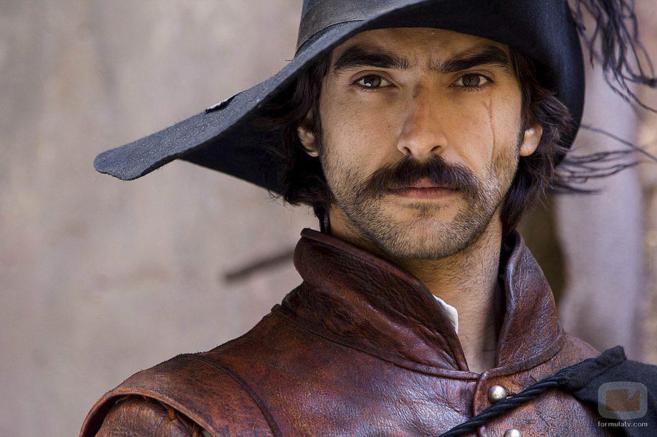 I’ve been deep-diving into history here at Rancho Malario, first with the Amazon Prime series Las Aventuras del Capitán Alastriste, based on the novels by Arturo Perez Reverte. I’ve been a fan of Perez’ fiction for a long while, ever since The Flanders Panel and The Club Dumas. The Alastriste novels are a very good introduction to his work, being fast-moving, action-oriented, and fun. They are also influenced strongly by Alexandre Dumas and his Musketeers.
I’ve only seen a few episodes of the TV series, but so far it’s exactly what I hoped for.
Captain Diego Alatriste (Aitor Luna) is a soldier-for-hire in the declining years of Spain’s golden age, employed to murder a couple inconvenient Englishmen who turn out to be the Duke of Buckingham (the Buckingham from The Three Musketeers) and the Prince of Wales (the future Charles I), who have come incognito to Madrid to court the Spanish Infanta. (This actually happened, by the way.)
Alatriste senses that something is wrong in this setup and saves the English instead of killing them, which plunges him into a shitstorm of court intrigue involving Philip IV, his chief minister Olivares, the Inquisition, and all their various torturing and murdering henchmen.
The novels are narrated by Alatriste’s young page Iñigo (Marcus Ruiz), and readers know only what he knows; but the series opens up the story, so we get to see all the various conspiracies in play, reaching all the way to Cardinal Richelieu in France.
Iñigo spends much of the novels being in love with the arch-conspirator Angelica de Alcazar, who is twelve at the start and very much like Milady de Winter, only far more evil. She is played with eerie perfection by Carmen Sanchez, whose acting shows a subtlety and maturity far beyond her years. (I found this pretty disturbing, and suspect a deal with the Devil.)
If the series continues— and why wouldn’t it?— the two juveniles will grow naturally as the story progresses, which would be kinda cool.
The cinematography is simply beautiful, and many shots are framed and lit, and the actors costumed, to evoke the paintings of Velasquez and other artists of the period. (It’s filmed in Budapest, not in Spain at all, but it still looks scrumptious.)
There are, I guess, a limited number of actors working in Spanish television, and when people from El Ministerio del Tiempo turned up, I began to wonder if Diego Alatriste had somehow attracted the attention of the Time Patrol.
Among the reasons to like this series is the Italian mercenary whose name translates to Walter Evilhead. Gotta love that.
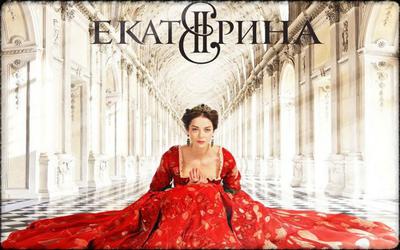 I’ve also checked out the Russian series Ekaterina, about the rise of Catherine the Great. The series takes place during the 17 years Catherine spent in Russia before organizing the coup that installed her as Empress.
The series seems to be reasonably congruent with the actual history, in which young Sophie of Anhalt-Zerbst (the astoundingly beautiful Marina Alexandrovna) is recruited to marry the nephew of the Empress Elizabeth, who has been designated as her heir. The formidable Elizabeth (Yuliya Aug) intends the newly-christened Catherine to function as breeding stock for the next heir, and blames her when years go by without her becoming pregnant. (The fault lies rather with her hapless husband.)
Portrayals of hapless husband Peter tend to follow Catherine’s autobiography and show him as a drooling imbecile obsessed with torturing animals and subjecting his servants to spontaneous military drills, but Alexander Yatsenko makes the character sympathetic without obscuring the reasons why Peter III had to be shuffled off the throne.
The series does an excellent job of portraying the atmosphere at the Russian court, where everyone is under surveillance all the time, and the penalty for political failure is arrest, torture, execution, and an unmarked grave.
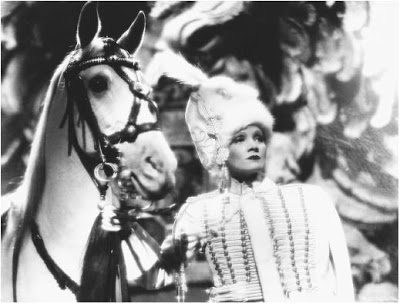 I topped this off with The Scarlet Empress (1934), Josef von Sternberg’s expressionist telling of the same story, starring Marlene Dietrich.
(Though royalty and power doubtless lend their own glamor, Catherine’s many portraits suggest she didn’t look even remotely like Dietrich or Marina Alexandrovna, but rather more like a plump German hausfrau.)
The Scarlet Empress is a bizarre exercise in style in which the actors take their places amid an enormous set filled with mirrors, shadows, dozens of wooden sculptures of men writhing in highly-stylized agony, and a skeleton laid out on the table of Catherine’s wedding feast. The joys of the wedding night are represented by an obscene cuckoo clock in the form of a woman flashing her nakedness in time to the calls of the cuckoo. (Kind of surprised Sternberg got away with that, actually.) Sam Jaffe plays Peter III as a sinister imbecile, and Louise Dresser, despite her Indiana accent, steals every scene as the Empress Elizabeth.)
Dietrich plays Catherine as a wide-eyed innocent who evolves into a calculating dominatrix, sleeps with much of the army, and then leads her lovers/troops storming into the palace, cackling maniacally as her boyfriend Grigori Orlov brutally murders her husband while bells and cannon ring out in triumph.
This is worth a look for its weirdness alone. Critics tend to use this film to psychoanalyze von Sternberg and his relationship with Dietrich, but that’s just a waste of time. I advise just opening your eyes and staring in gobsmacked amazement. There’s really nothing like it.
Reader responses
Comments
Be the first to respond.