
March 16, 2012
Junior G-Men
Friend of the blog Ralf sent me this useful document telling us how to spot terrorists and spies in Internet cafes.
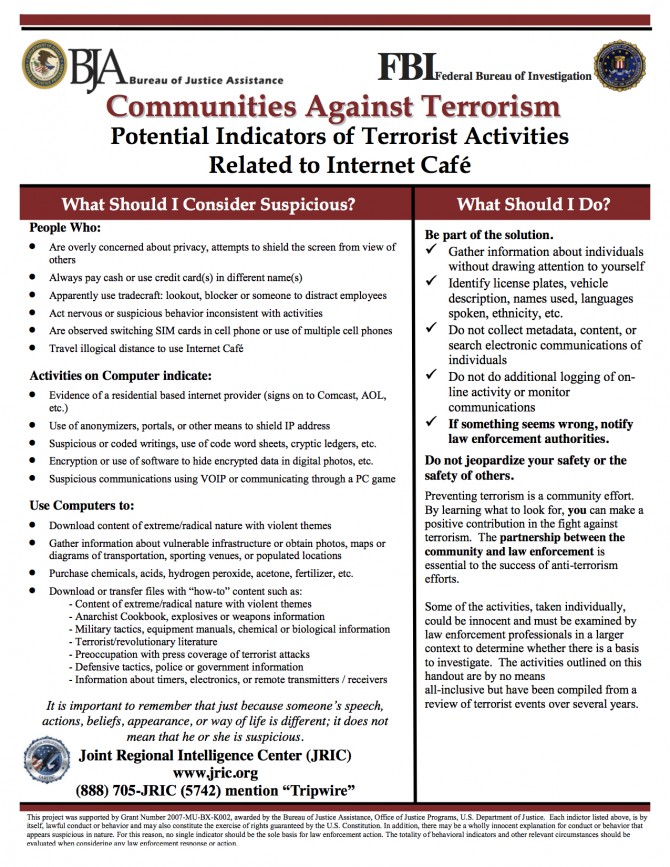 Suspicion should be directed, for example, at people who are attempting to maintain privacy while browsing (in a public cafe). Or folks who use ciphers, or who travel long distances in order to use the cafe. Or who pay in cash.
I’ve done all of these things. I’ve used Internet cafes in places far from home, like Prague, Lyon, and Ankara. I’ve made efforts to maintain my privacy in these public settings. I’ve even used public-key encryption now and again. I’ve been seen in the company of a “lookout”— well, a friend— who hung around the cafe while I was doing my business. And I’ve paid in cash, because handing over a credit card for twenty minutes’ worth of Internet time didn’t seem like the best use of the card.
(But then, I am a suspicious character.)
You know, I could give one of my usual long, sarcastic rants at this point, but in fact I’m not opposed to involving the citizens in matters of national security. Generally I’m more in favor of it than not.
(Think about it, now. Who would you rather be involved in security matters: an active and informed citizenry, or a group of government elites who act in secret and talk to no one but their peers?)
As a document, it’s fairly unexceptional. It has sensible disclaimers. It doesn’t say, “Report all foreigners and weirdos.” It gives a list of things to look for and hopefully suggests, rather than urges, common sense.
It’s also unlikely to be effective, because this is an exception. For the most part our elites want to keep this stuff away from ordinary people. “Move along,” they say. “We decide policy. Nothing to see here.” It’s not like they want to see us suddenly pay attention.
This sort of thing works only as part of a concerted campaign designed to catch and focus the public’s attention. In Israel, for example, even children’s programs come with public safety announcements about terrorism, and they’re pitched not to frighten the kids, but to make them feel empowered.
You can make yourself and your families safe, they say, and here’s how.
Can we do that sort of thing here? Can we even tell students what to do if an “active shooter”— a Dylan Klebold or an Eric Harris— walks into a classroom with a gun? (Hint: hiding under a desk until they get bored and decide to leave is unlikely to be effective.)
Nope. We aren’t to be trained in how to defend ourselves, we’re trained to be consumers . . . and victims. Which are often the same thing.
Reader responses
Comments
Be the first to respond.