
May 4, 2012
Marginal
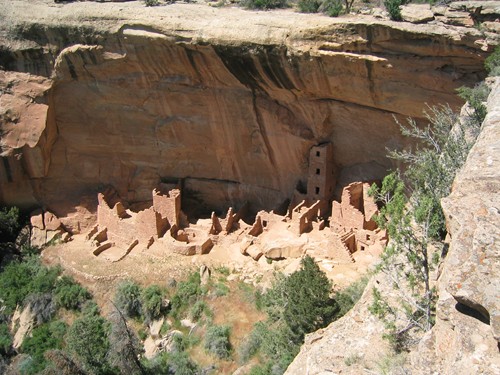 Being at the Secret Site last week, along with some remarks from friend of the blog Ralf, have set me thinking about life on the margins.
Those folks on that mesa-top pueblo lived there for several generations at least, and got by. They planted crops with a digging stick, and they had to irrigate them with water carried in clay pots from a spring, but they got by. They made tools, looked after their domestic turkeys and dogs, caught game— there were elk tracks all around, and back in bygone days there would have been buffalo— made tools, made pots, made babies.
Life wasn’t impossible. Life was just hard.
Resources were limited. That’s why you had small family or clan groups living on rocky outcrops, because people had to disperse in order not to use up all their resources.
At some point the whole culture dried up and went away. Resource depletion? Drought? Civil war? Nobody knows.
Certainly the climate got drier. We can all imagine what a 50-year drought might do to, say, Los Angeles.
Near the spring that fed the Chacoans and their crops were the remains of a homesteader’s house from the 1920s. Homesteaders got 160 acres free of charge, provided they hung around for five years and “improved” the property, generally by building a house on it. Because I was in the company of one of the homesteader’s descendants, I knew that the homesteader ran 2500 sheep in the area.
The house was made of the same material used by the Chacoans, local stone. A huge boulder conveniently formed one wall, with a slot carved in it for a beam to hold up the roof. Other big rocks had been moved into formation, and the spaces between them filled in with small rocks.
Like the Chacoans, the homesteaders made some effort to control the water on their property. Chacoans would have built check dams and other features, the homesteader put in a big water tank used by the livestock.
Aside from the livestock and maybe an automobile, the homesteaders had another big advantage: they didn’t have to worry so much about armies of their neighbors attacking them. But their day-to-day lives weren’t that different from their predecessors. They worked, they tended their animals, they hunted game. Life wasn’t impossible. Life was just hard.
I don’t think the homesteaders lasted the five years— at any rate, the property isn’t in the family now. It wasn’t that their life was impossible, it’s that there were other opportunities for them, and they left to take advantage of them.
Which is where the 20th Century took us, from a society where 60 percent of the population lived in rural areas to where 21 percent lives today. (And just because you live in the country doesn’t mean you live an agrarian lifestyle— I live in the country,and I don’t farm or ranch.) 39 percent lived on farms in 1900, now it’s 1 percent. And the number of commodities produced by any individual farm dropped by 75 percent— where in 1900 farms produced nearly everything the farm family needed in the way of foodstuffs, now they just produce a single crop, and sell it to corporations.
The government engineered a lot of that change, in the years after World War II. As I pointed out in The Rift, the government (in alliance with what is now called agribusiness) made it easy to move from the farm to the cities. They didn’t do anything as destructive as force people off the land: they just created opportunities elsewhere. For instance, they provided college scholarships to farm youth, knowing perfectly well that college-educated young people are unlikely to move back on the farm. Agribusiness offered its own inducements.
Rural society was more or less destroyed. 38 farmers moved away for every one who stayed. As I also mentioned in The Rift, rural societies tend to favor apocalyptic religions because the apocalypse has already happened to them. Those who live there now witnessed their entire culture and way of life destroyed.
When I drive to the Jack Williamson Lecture every year, I see proof of that: little ghost towns and near-ghost towns, shuttered stores and gas stations, closed post offices. Tolar, Yeso, Ricardo, St. Vrain . . . places with more abandoned houses than there are human beings.
Yet people left those towns voluntarily, for a life that wasn’t so hard as the one they were born to. They weren’t attracted merely by a better material lifestyle, but also educational opportunities for their children, access to medical care and elder care, contact with the wider world.
I’m glad I don’t have to make the choices the Chacoans did, or the homesteaders, or even my parents. (My mother grew up in a farmhouse that was never actually finished, because her father died and everyone else had too much work to complete the structure. It had a roof and a stove, and everyone made do with that.)
I’m happy for my opportunities, but seeing the Chaco Culture ruins and the old homestead makes me all too aware of how fragile it is. I’m living now in a drought that’s been going on for 20 years, more or less, with a few wet years in the middle. I’ve seen the changes that it’s inflicted on the landscape. (Last year featured the biggest forest fires ever for New Mexico, Arizona, and a single wildfire in Texas consumed more land than can be found in the state of Delaware.) And evidence suggests that climate change is only going to get worse.
I sure am tired of spending my summers breathing smoke.
And the huge boom in post-apocalyptic novels suggests there’s something in the zeitgeist that mirrors all that. I’m old enough to remember the boom in Bomb novels, but now it’s either climate collapse or the Dictatorship of the One Percent.
So what are the odds of us, or our descendants, moving back into those homesteaders’ rock huts? Not very high. We’re the First World, thank God.
But straightened circumstances, high energy prices, high food prices? Oh yeah. Some of that will be mitigated by our increased efficiency, and by the effects of the Third Industrial Revolution. Watching on television as billions die of starvation, disease, war, and famine? Hey, that’s already started! (You think last year’s revolts in the Middle East weren’t a response to higher energy and food prices for people already living in the margin? And what’s going to happen when the new governments don’t deliver cheaper food, hmmm? Jordan is already bankrupting itself subsidizing food and fuel.)
So yep, we all get to move closer to the margin, and some might topple off.
One thing we can be sure of, out politicians won’t be talking about any of this. Too depressing, too real. They’ll find something else to occupy the public’s attention, like whether illegal immigrants should be electrocuted or whether Obama eats dogs.
Sorta feels like we’re being fed canine ourselves, doesn’t it?
Reader responses
Comments
Be the first to respond.