
November 23, 2010
Mongol
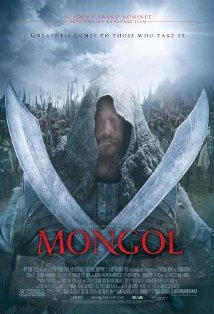 When I was a child, Omar Sharif was my image of Genghis Khan. I had seen the big-screen Hollywood biopic, perhaps the last to be made in the tradition of Ben-Hur and El Cid, with Omar as Temudjin, Stephen Boyd as the villainous Jamuga, and Robert Morley, of all people, as the Chinese Emperor. The love interest, Temudjin’s wife Borte, was played by the astoundingly blonde Francoise Dorleac (Catherine Deneuve’s older sister). Other notable Caucasians in the cast included Eli Wallach, James Mason, and Telly Savalas.
I do not believe there were any actual Asians in this film about an Asian conqueror conquering other Asians. I daresay this film would be pretty campy if viewed today.
I finally got around to watching 2007’s Mongol, the latest Genghis Khan epic, in which I do not recall seeing any Caucasians. Where has tradition gone?
Instead, we have part-Japanese, part Navajo Tadanobu Asano as Temudjin, the Mongolian actress Khulan Chuluun as Borte, and the scene-stealing Chinese Sun Hong-Lei as Temudjin’s blood brother, rival, and deadly enemy Jamugha. The rest of the cast are either Han Chinese or from a variety of Central Asian ethnicities, and all are directed by the Russian Sergei Bodrov, who also wrote the screenplay.
Asano and the Mongol cast members speak Mongolian, and the Chinese speak Mandarin, but they’re all so damn good you don’t really notice that they’re speaking very different languages. Actually shot in Inner Mongolia and Kazahkstan, the film is full of long, stately, gorgeous shots of the plains, buttes, and river valleys of Central Asia. The endless shots of the composed, beautiful, lush scenery slows down the movie quite a bit, but I can’t say I much minded.
The film reminded me what a melodrama the young Khan’s life actually was. Temudjin survived the assassination of his father, captivity at the hands of his enemies, the escape that followed, and the abduction and rape of his wife Borte, who he rescued but found to be pregnant. (He raised the child as his own.)
He then united the Mongolian people, mostly by killing those who didn’t agree that he should run things, and then began his legendary campaign of conquest and bloodshed. But all that will be in the second film of what is promised to be a trilogy.
That’s where this first film runs into trouble. The first half is enthralling; but since the next part of the story is reserved for the next movie, Bodrov settles for giving us the first half all over again. Again Temudjin is kidnaped, and in the course of rescuing him Borte is forced to sell herself to a Han merchant, and again ends up pregnant, and again Temudjin accepts this second child as his.
In the long-postponed finale, we get the final confrontation between Temudjin and Jamugha over who’s going to run the Mongol state, and there’s a big battle scene in which most of the film’s CGI budget is expanded. It’s quite an effective battle scene, though spoiled a bit by a quite literal deus ex machina that causes Temudjin’s enemies to flee at a critical moment. Jamugha is captured, but allowed to go free. (The real-life Temudjin broke Jamugha’s back and left him to die. Which wasn’t [entirely] cruelty, but the traditional method of executing a noble.)
The acting is uniformly excellent, the direction gorgeous and just the least bit ponderous. Khulan Chuluun is distractingly beautiful, if somewhat wind-chapped.
I’ll look forward to the next film, and I hope it has a bigger budget and can afford real armies.
Reader responses
Comments
Be the first to respond.