
October 6, 2011
Prayers on the Wind
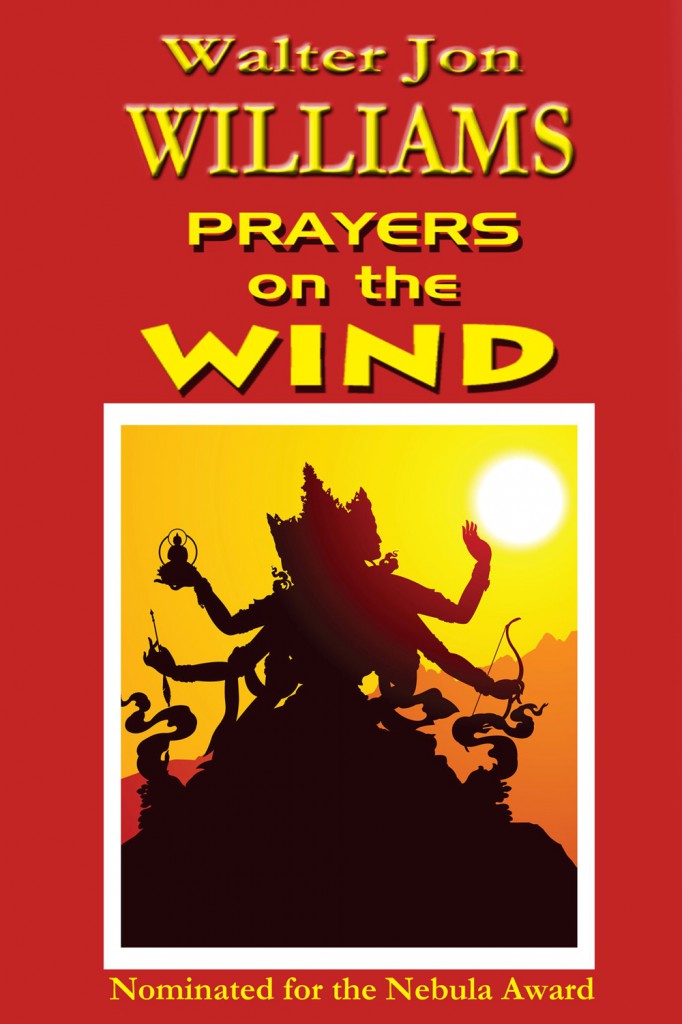 I got a little weary of copy-editing entire novels, so I decided to make my Nebula-nominated novelette, Prayers on the Wind, available for your reading pleasure. You may download it at Amazon, Barnes & Noble, and Smashwords.
It’s only 99 cents! What have you got to lose?
The story was written at the request of the writer Lewis Shiner, who was putting together an anthology in response to a brand new fiction category— military SF.
The Eighties were very kind to subgenres. Although there had always been plenty of stories about future war, combat with aliens, and general derring-do, the Eighties was the decade in which military science fiction became a category of its own.
The same thing happened to cyberpunk and steampunk. (Alternative history really didn’t get rolling till the Nineties.)
Anyway, the racks were laden with books proclaiming that the future of the human race would be filled with blood, slaughter, massacre, xenocide . . . One series proclaimed on its cover that There Will be War. (A series to which I contributed, incidentally, a comic tale of Scottish Highlanders encountering ghosts on an alien world.)
(By the way, the notion that the future of humanity will be filled with conflict seems to be contradicted by the evidence.)
Anyway, Lew thought there ought to be an anthology offering an alternative— stories of the future where war was avoided, or impossible. And so I put my mind to it.
One way to make war impossible is to re-engineer the human race. But in that case they’d no longer be human, they’d be Asimovian robots. If you don’t indulge in violence because you have no choice, there’s no story, because stories are about choices and their consequence.
Another possibility is to displace the violent urge onto something else, like Rollerball. But I’d seen the movie, and it was a cliche even then.
Then I thought, Well, what if one of our major religions turns out to be objectively true, along with its moral teachings? Would that motivate people to behave, or not?
This couldn’t be Christianity or Islam, because they have war kinda built in with that Battle at the End of Time thing. If Judaism turns out to be true, it matters primarily to the Jews. Confucianism isn’t a real religion, and Taoism is all over the map.
And so . . . Buddhism. Which is at least technically a pacifist religion that says that all violence and killing are wrong.
Of the various Buddhisms available, I picked the Tibetan variety because (1) there’s only one guy in charge, so I could put a single person at the center of the moral and political argument, and (2) Tibetan Buddhism is really, really weird, which is good from the point of view of a writer. There are native sorcerers in Tibet that practice Bon, which is either a variant of Buddhism or another religion entirely, depending on who you talk to; and Tibetan Buddhism is also strongly influenced by Tantrism, which (as Lew put it) is a “really sick religion.”
A lot of details and local color were courtesy of Alexandra David-Neel’s Magic and Mystery of Tibet. David-Neel was a French convert to Buddhism who traveled in Tibet disguised as a lady lama, and who was Buddhist enough to understand the religion but Western enough to be skeptical of its claims. (She lived an incredibly adventurous life, wrote many books, and died at the age of 101.)
And how do I make the claims of Buddhism objectively true? You’ll have to read the story.
Oh— one more thing. There’s a character in the story, an alien, named !urq. (The exclamation point is intended to be pronounced as a click, as with the !Kung bushmen.) The fact that it’s pronounced something like “Kirk” is not accidental. I put into !urq’s mouth all of the arguments that might be made by the captain of the Enterprise when confronted by a culture that’s pacifist, passive, and indifferent to the notion of progress.
So how did the anthology do? Not well. Lew always uses lyrics and titles from rock songs in his fiction, and When the Music’s Over somehow did not say “peace anthology” to its prospective buyers. (I don’t know why Give Peace a Chance wasn’t somewhere in the mix.) The cover didn’t help. By the time the book was published, the publisher was no longer really behind it. It appeared for a while, then faded.
Still, the anthology sold to enough of my fellow writers to get me a Nebula nomination, but not enough to win.
And now you all have a chance to read it, all on its own.
Reader responses
Comments
Be the first to respond.