
February 21, 2012
Reviews Too Late: The Eagle
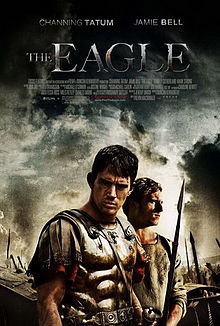 I finally got around to seeing The Eagle, which was one of two films released in 2011 that dealt with the disappearance of Legio IX Hispania north of Hadrian’s Wall sometime around 117 CE. (I offer a brief review of the other film here.) Which just goes to show you that when it’s Legio IX Hispania time in Hollywood, it’s Legio IX Hispania wherever you look.
This is by far the better of the two films, in part because it’s based on Rosemary Sutcliffe’s The Eagle of the Ninth. I read this classic YA when I was twelve or so, but I haven’t revisited it since, and my memory of the book is rather sketchy.
Channing Tatum stars as Marcus Flavius Aquila, a young centurion commanding a fort in a remote part of northern Britain. Turns out he’s the son of an NCO in the Ninth Legion who has been blamed for the loss of the legion and its eagle standard. Marcus is determined to regain his family’s honor.
(The film seems a little confused about Roman ranks. As I remember the novel, Marcus’ father was the aquilifer, or standard-bearer, of the legion, and there fore it made a kind of sense that he was blamed for the loss of the eagle. In the movie, he’s just a senior NCO, so blaming him for the disaster seems a little excessive. No one at any point seems to think of blaming the upper-class twit who actually led the Ninth Legion into the ambush and got it wiped out.)
Marcus saves his fort from being overrun by a horde of shrieking Brigantes, but is wounded in the action, decorated, and honorably discharged. Since he’s depressed at the termination of his military career, his wise uncle, Donald Sutherland, decides to cheer him up by taking him to a gladiator show. (Nothing buoys an ancient Roman like the sight of a slaughter.) Marcus is impressed by the bravery of a Brigante slave, Esca, and buys him. (Esca is played by Jamie Bell, who I last saw larking about in Billy Elliot. He doesn’t get to do much dancing here.)
Marcus hears that the eagle of the Ninth Legion is being held as a trophy north of Hadrian’s Wall, and decides to go with Esca to find the eagle and retrieve it, along with his family honor. As I recall, Marcus-of-the-novel disguised himself as a Greek ophthalmologist or something, which made a kind of sense. Marcus-of-the-movie is really, really thick, so he goes north disguised as Marcus Flavius Aquila.
After many adventures in which Marcus demonstrates his (a) courage, and (b) general lack of brains, he discovers that the eagle is being held by the Seal People, who seem to be Iroquois transplanted north of Moray. (I mean, they’ve got scalplocks and stone tools and live in wigwams. At times, when the Seal People were chasing our heroes, I wondered if I’d walked into a showing of The Last of the Mohicans.)
The only way our heroes can infiltrate the Seal People is for Esca to pretend to be the master, while Marcus is forced to be his slave. Marcus, being thick, doesn’t much care for this, so of course Esca is forced to kick his ass in order to demonstrate who’s the new boss.
All is set to rights when our heroes steal the eagle and hightail it back for the border, pursued by the Iroquois or Seal People or whoever. Marcus’ wound acts up, and he orders Esca to return without him, but in a scene of near homoerotic intensity, Esca professes his devotion and refuses to leave. And then there’s the ending, which I won’t give away.
The film’s greatest strength is also its weakness, in that it makes no concession to modern values. Marcus is a freakin’ Roman, and nothing else. He likes gladiator shows. He is a sincere devotee of Mithras, to whom he prays not to disgrace his unit. He has no problem with slavery, so long as he’s not the slave. He’s a member of the master race who is there to kill the enemies of his people and to redeem his father’s name, and he has no respect whatever for the value of human life, particularly British life. The brutalities of the Roman conquest are not at all minimized or glossed over.
And above all, Marcus cares about honor, and not much else.
Honor, honor, honor. A lesser movie would give him a girlfriend or something, but this one is entirely about military and masculine virtues.
For this reason it’s rather hard for a modern viewer to warm up to Marcus. He’s so uncompromisingly of his own time, and he stands in complete contrast to our own.
Mind, I think this is a good thing in a historical film. The movie does a good job of showing why Marcus thinks the way he does, and it demonstrates his virtues as well as what a modern audience would consider his flaws.
The film wasn’t a financial success, though at least it made most of its money back. A shame, because I’d like to see more of Rosemary Sutcliffe’s novels turned into films.
Reader responses
Comments
Be the first to respond.