
February 5, 2013
Revised? Updated?
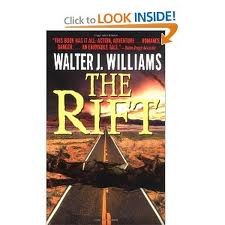 As you all surely have noticed, not least because I keep nagging you about it, I’m reissuing my backlist in ebook form. I have only two books left, one last privateer book and The Rift. (Plus, of course, a whole lot of short fiction.)
The privateer book just awaits sufficient time to format it and fling it onto the electronic seas of the Internet, but The Rift is a special case.
For one thing, getting it in shape is going to take a while, because it’s my longest work. 310,000 words, more than 700 typeset pages in the hardback edition. The manuscript itself was something like ten inches tall.
So simply copy-editing and formatting the scan is going to be a lot of work. (Fortunately, Kathy is a very good copy-editor.)
But another, rather larger issue concerns whether I want to spend any time rewriting the manuscript. Because the book first appeared in 1998, and it has been overtaken by history.
Not that there’s anything that’s would strike a contemporary reader as particularly obsolescent or wrong. General Jessica would have a much easier time setting up a secure satellite network— we’ve got satphones now, and there’s MESA.
The problem is that so many of the events of The Rift have, um, actually happened. Sort of.
No, there hasn’t been a series of massive earthquakes along the New Madrid Fault causing levee breaches, massive flooding, and serious social disruption. But there have been a few other disasters that have made their mark on the Mississippi Valley.
Chief is Hurricane Katrina. When Katrina happened I suffered from an intense sense of déjà vu, made deeply, profoundly depressing by the authorities’ strategy for dealing with the crisis— “let’s have a whole bunch of black people die.” In The Rift, the racial tragedy is largely the work of bad people— in Katrina, it was just the default tactic of everyone involved, including the New Orleans city administration, which of course was run by black people and who could think of nothing better to do but enact the region’s cultural imperative.
The other major event prefigured by the novel was the Fukushima meltdowns following the 2011 Tohoku Earthquake in Japan. People in the novel spend a lot of time trying to rescue a nuclear power station from earthquake, flood, and errors of design.
When I watched Fukushima happening on CNN, I couldn’t help but think that I’d written the script.
There have been other events that have impacted the Mississippi Valley since 1998. To mention only the obvious, the floods of 2002, 2008, and the huge catastrophe of the floods of 2011.
I’m trying to decide if I want to rewrite The Rift so that its characters are aware of this history. Should I even attempt it?
The Rift is disaster novel. It may be that all disaster novels have a built-in sell-by date. Take, for example, all those books that involved a nuclear exchange between the U.S. and the Soviet Union. No matter how good they were— and Alas, Babylon and On the Beach, for two, were very good— they’ve now subsided into irrelevance.
Or take a classic in the SF field, Lucifer’s Hammer. A comet hitting the Earth is still a threat relevant to today’s audience, but the astronauts returning to Earth in their Apollo capsule might raise a few eyebrows, along with the book’s villains— who, you may remember, were an army of black nationalist cannibals led by Jerry Brown. I’m thinking this is no longer on anyone’s Top Ten List of Things to Worry About, assuming of course that it ever was.
Even the best of the old disaster novels have grown twinkly and quaint. I wonder if I should let The Rift age gracefully along with them.
Even more problematic is the question of a rewrite raising more problems than it solves. If the characters display knowledge of such events as Katrina and Fukushima, would their actions remain the same? Or would they behave completely differently, and with a different mindset?
I’m completely undecided, and have barely begun to grapple with the problem. That means I’m open to influence— your influence.
Tell me what you think.
Reader responses
Comments
Be the first to respond.