
October 29, 2013
Rifting Down the Mississippi
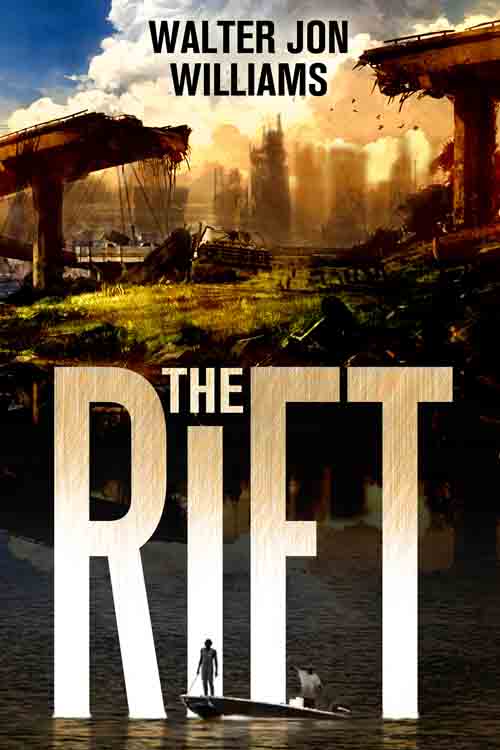 Some thoughts on my novel The Rift, which has now been re-released in electronic form, and is available via Amazon, Nook, and Kobo. (I’ve been trying to load and convert the file onto Smashwords for something like 30 hours, and it seems to have comprehensively crashed. All I can get now is “500 Internal Server Error,” which can’t be good.)
The Rift was my biggest book in the most literal way. 310,000 words, about the size of A Game of Thrones, so large that it tested the limits of the bookbinder’s art. Intended as a breakout book that would enhance my career, it instead brought my career to a staggering, screeching, gear-stripping, smoking halt.
Before The Rift, my career trajectory was a nice, smooth rise.
After The Rift, I didn’t sell another book for five long years.
The Rift was “published dead,” which is to say brought into print without any of the support from the publisher that would have guaranteed its success. The publisher might as well have decided to take all the money it has spent on the venture, pile it up, soak it in gasoline, and set fire to it.
And it wasn’t the last of my books to be published dead, not by any means.
But before going into that, a bit of background.
Beginning in the early 1990s, American publishing went through a fundamental change known as the “collapse of the IDs,” the Independent Distributors that put books and magazines on the racks of your local supermarket or drugstore. When the IDs went “in play,” they were reduced from over 200 to under 10. (I believe they’re now under five.) As the IDs oompacted, the fundamentally brain dead ideas of modern, rationalized management were applied to the trade by the speculators and hacks who bought up the businesses, and the result was that the sales of mass market paperbacks declined by something like 50%. (Apply new business principles, lose half your business. And then congratulate yourself for your financial genius! Such was the spirit of the Nineties.)
Since most of my sales were in mass-market paperbacks, I didn’t relish the notion of losing half my sales.
I had just got through the bruising business of writing Metropolitan and City on Fire. Neither of those books were easy to write by any means. City on Fire was particularly tough, because it was quite the doorstopper in its own right, over 200,000 words. I was a year later in delivering it, I’d had to hire a lawyer and threaten to sue the first publisher who bought it, and remember, I’d never intended to write a series! I’d thought Metropolitan would be only one book, and then I’d get on with other things.
Anyway, I found myself physically and spiritually exhausted, and I badly needed a break from the Metropolitan books. My sales were being threatened by developments outside my control. I needed to take charge.
I flew to Texas for a signing for Metropolitan, and the Texas fan and bookstore manager Willie Siros drove me from Austin to a bookstore in Houston (or maybe San Antonio), and on the way we stopped at a roadside joint in Bastrop for lunch, and he told me about geologist friend of his who was researching some of the macro effects of the New Madrid fault, the giant earthquake fault that runs down the Mississippi from, roughly, St Louis to Memphis. There had been three huge earthquakes over the winter of 1811-12 (which I vaguely knew about), and which had destroyed parts of Missouri and the surrounding areas. Large parts of the country sank beneath the water, and islands rose where there had been none. There were tsunamis on the Ohio River and falls on the Mississippi. Uncounted lives had been lost, but casualties were relatively low because the area was thinly populated, only maybe 5000 Europeans. There were lot of American Indians, of course, but their stories have not been preserved in history.
And, in the years since, fifty million or so people had moved to the earthquake zone, and practically none of them lived in earthquake-approved structures.
Well, I thought, that might make an interesting blockbuster. Because a blockbuster was something I was looking for.
Fiction is, of course, the home of multiple genres, but one of the most intriguing of genres is that of big bestseller. Big bestsellers might technically be in one genre or another— historical, say, or thriller, or romance— but in fact they transcend these genres. As Gertrude Stein might say, a bestseller is a bestseller is a bestseller. Bestselling authors write any damn thing they want, and somehow they remain bestsellers. From the outside at least, this seemed pretty sweet.
I wasn’t trying to make money so much as preserve my independence. Swing a big enough dick in the world of publishing, and nobody’s going to tell you what to write.
A big bestseller might be the solution to my problem of losing half my paperback sales.
Fortunately my agent and my editor agreed, and I not only sold The Rift, but I got a big bestseller six-figure advance for it.
And I was going to do this book right. I was not only going to do massive amounts of research, I was going to traverse the country I was going to write about.
In October of 1996 I and a friend drove the Mississippi from New Orleans north. I talked to everyone I could along the way, lock keepers, ladies dressed for Natchez Pilgrimage, bartenders, ferryboat operators. I corresponded via email with bond traders and engineers. I visited Mound Builder sites, antebellum mansions, slave cabins, Graceland, Civil War sites, graveyards, black history museums, the wonderful Rural Life Museum outside of Baton Rouge, riverboat casinos, the “home of throwed rolls” in Sikeston, MO, the headquarters of the Mississippi Valley Division of the US Army Corps of Engineers, the National Civil Rights Museum in Memphis, and the Tom Sawyer Caves in Hannibal. I muttered notes into a handheld tape recorder and transcribed them each night.
My characters would be taking this trip in reverse, drifting down the Mississippi in a banged-up bass boat, a modern-day Huck and Jim encountering the terrors and follies of their flooded universe.
I ended my trip in Chicago at the World Fantasy Convention, where the fact of the collapse of the IDs, and the loss of paperback sales, were just being felt by the writers. There was the tang of flop sweat in the air. Careers were threatening to collapse on all sides as everyone adjusted to the fact of lost sales. I congratulated myself for neatly evading this trap.
And then I sat myself down to write the book, and— as with City on Fire— it promptly ran out of control. Pages began piling up. Subplots multiplied.
And, as with City on Fire, I had an outline. Outlines are supposed to prevent your work from running amok, but somehow this one didn’t. I began slicing out whole storylines. It didn’t help.
Day after day through two long summers, I sat in a boiling-hot house, wearing only a pair of swim trunks, with a towel around my neck, writing while the sweat dropped off my nose into my lap. We now have refrigerated air, but in those early days of living in Droughtland we didn’t, we had swamp coolers, and the swamp coolers were incapable of making head against the scorching temperatures.
By and by, I finally finished the book. It was a year late and three times as long as I’d planned. As far as I was concerned, Harper Collins had got 200,000 words for free.
My editor John Douglas modestly opined that the work was terrific. “We can either work on this really hard and cut maybe fifteen percent,” he said, “or I can just send it to production and see what they say.” Production said nothing, and the book came out more or less as she was writ.
But it came out dead. Not because of me, but because of internal politics at Harper.
In that period Harper Collins was losing tens of millions of dollars per year. (I have heard eighty millions in losses that year, but have no way of confirming it.) Harper is a huge bureaucracy, and had a kind of insane legacy structure of of a Paperback Division and a Hardback Division, which naturally were at war with one another. (The Paperback Division could always make sure that the Hardback Division’s books failed when they hit mass market.)
There was one division of Harper that made money, and this was the new science fiction line run by John Silbersack and John Douglas. Clearly this could not be allowed to continue— they were making everybody else look bad. So the science fiction line was expanded to include a lot of divisions that lost money— like calendars, which of course have so damn much to do with science fiction. Silbersack saw the writing on the wall and bailed, leaving John Douglas in charge of a ship that was taking on water fast.
Now another way that you can destroy a fiction line is to make certain that their books fail. Here was John Douglas with a big wannabe-blockbuster for which he’d paid a six-figure advance. If all that money could be flushed down the toilet, that would be a black eye for John, and good news for the incompetents in the other divisions.
So what do you do to make sure a book fails? Well, if it’s a wannabe-blockbuster, you publish it as science fiction, which it isn’t. The Rift came out from HarperPrism, the SF line, and did about as well as my SF, which was fine for SF but of course catastrophic in terms of blockbusterdom.
Ere long, HarperPrism was no more, John Douglas was out of work, and I believe the mass market paperback of The Rift was its last release. (You don’t ever want to be the last release of a fiction line, you just don’t.)
Nobody wanted to buy a new big book from me while we waited to see how the first one did, and of course nobody wanted anything at all after the book flopped. I naively thought I could don my SF hat and write Metropolitan III, but my agent said he couldn’t sell it. Plus, there was no longer HarperPrism to sell it to.
And who gets blamed when a book fails? The author, of course. I’d cost the publisher a lot of money, and it was all my fault even if the publisher had set out to lose that money in the first place.
So that was that. I lost not only Metropolitan III, but the big book I’d intended to follow The Rift. Nobody wanted my fiction because I had this big L for Loser branded on my forehead So instead I wrote some movies that I got paid for, but that didn’t get made. I scripted a video game that didn’t get made, either. But still, that six-figure advance rolled in installments over the years, and I had money in my pocket.
When the call came, it came via LucasFilm. My next book was to be a Star Wars tie-in, the writing of which was a very intense experience that, to my surprise, I rather enjoyed.
My agent in the meantime was negotiating hard to keep my advances up, and in the end I sold the Praxis books to Harper’s new SF line for pretty much the same money I’d got for the Metropolitan books.
All I lost was about seven years of my productive life. If I’d just gone on chugging out one SF novel per year, I’d have made more money, and maybe not lost so much momentum.
What happens when you go all-in on a big gamble and lose? Even if you find out subsequently that the game was rigged, you’ve still lost the money, the time, and a very large slice of hope.
The problem was that I couldn’t stop caring. I cared about The Rift, I cared about the hard work I put into it, and I cared about what happened to all that work in the end. I can’t help but think that it deserved a lot better than to be caught in a power struggle between inept publishing company executives.
What I mostly got out of those lost seven years was a lot of frustration and disillusionment. The only positive thing during that period was The Rift itself.
And now The Rift is back! And maybe, fifteen years on, it has a chance of finding the audience that the publisher originally denied it.
Reader responses
Comments
Be the first to respond.