
August 3, 2012
Sailing into Your Corner of the Internet . . .
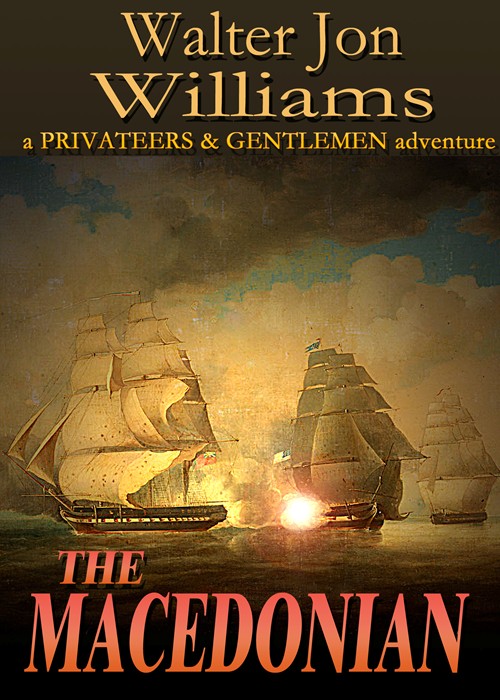 The Macedonian, the sequel to Brig of War, has tied up to the pier at Amazon, Barnes & Noble, and Smashwords. Feel free to come aboard.
As you can see from the somewhat altered cover, I took to heart comments on the mixture of serif and non-serif typefaces.
As for those of you who hoped for an cover design with greater uniformity to that of Brig of War, I can only wish I was able to oblige. Unfortunately this would require my finding a piece of art as good as the previous book, and this I couldn’t do.
I have found some pretty good pieces of art, but those were more suitable to later works in the series, and that’s where they’ll go.
One of the things to note about The Macedonian is that it’s the middle part of what was once going to be a single volume.
I was originally going to write only a single book about Favian Markham, containing more or less everything that now exists in three rather lengthy volumes. This is an early example of my inability to figure out exactly how many words it would take to tell a story (and it’s far from the last).
When Brig of War went well over a hundred thousand words, I realized it was time to bring the volume to a conclusion. I found a good triumphal ending point, and planned the next volume.
Which actually involved signing a new contract. So there was a modest delay before The Macedonian got underway.
And once again I ran into the same problem. At 100,000 words, I found myself a cliffhanger and postponed the finale to the next volume.
Fortunately Favian’s story ended with the next book, Cat Island, because that was the last book Dell bought. My plan for a ten-volume series died, if not in the cradle, at least in mid-adolescence.
The Macedonian and Cat Island appeared three years after the previous books in the series, just so that all momentum was completely lost. In fact Dell’s right to publish them had expired by that point, a fact which I took pains not to point out for fear that the books wouldn’t be published at all.
(More detail on the publishing history of this series in one of my posts on the writer’s life.)
The major theme of The Macdonian concerns division and unity, and is introduced in the opening scene, where Favian is the defendant in a court martial so torn by division and anger that the President of the Court is damning the deputy judge advocate before the man can complete a sentence. There follows a scene in which Favian witnesses Revolutionary Tories parading their allegiance to King George in the middle of Manhattan, then visits Robert Fulton’s experimental steam “oaken-clad” warship, Demologos. The name translates as “Voice of the People,” but what are the people actually saying as regards this war?
The War of 1812 was an incredibly divisive conflict, and came close to tearing the country apart. The declaration of war was a triumph of hope over experience— it’s not like our previous invasion of Canada had brought much glory, or Canada either. New England threatened secession under the banner of States’ Rights (a political principle which they, not the South, then defended). A subplot in the novel concerns a group of spies sending signals to British ships from Groton Long Point— those signals were very much rumored at the time, and no one found it particularly surprising that Americans would be working for the enemy. (New Hampshire and Massachusetts refused to place their militia under federal authority, and Nantucket went so far as to declare its neutrality.)
These conflicts are mirrored by conflicts among the ordinary sailors, when one of them is accused of being a witch on account of his being born in Finland. (Sailors generally believed that Finns were witches well into the 20th Century, and enterprising Finns did good business selling charms for good winds.) I had a bit of fun by casting my grandfather, Vihtori Kuusikoski, as the Finn in question. (No, I am not so old that my grandfather fought in the War of 1812.)
In the novel, Favian is challenged to heal the divisions on his ship. Healing the divisions in the nation were a little beyond his scope, but a sea-change seems to have been wrought by the burning of Washington. With the capital (and capitol) a smoking ruin, the country seems to have decided to stop fighting each other, get busy, and win the war.
(Which they didn’t do, actually. Nor was Britain the victor. If anyone won the War of 1812, it was Canada, the scattered provinces of which seems to have discovered something like a national identity. And the Canadian militia performed much better than the American, which often refused orders or ran away.)
Cat Island, the third book in the Favian Markham trilogy, features the Battle of New Orleans from a naval perspective, which you don’t often get. And it features Jean Laffite, because suave French pirates are pretty much irresistible from the novelistic point of view.
Incidentally, as part of the research for that book I read a biography of Laffite that claimed that he later moved to Alton, Illinois under the name Lafflin, opened a gunpowder factory, and later became a Socialist and donated his pirate booty to the First International. Which is just weird enough to be true, for all that the documentation is not terribly convincing . . .
Reader responses
Comments
Be the first to respond.