
July 31, 2012
Son, That Brig Has Sailed
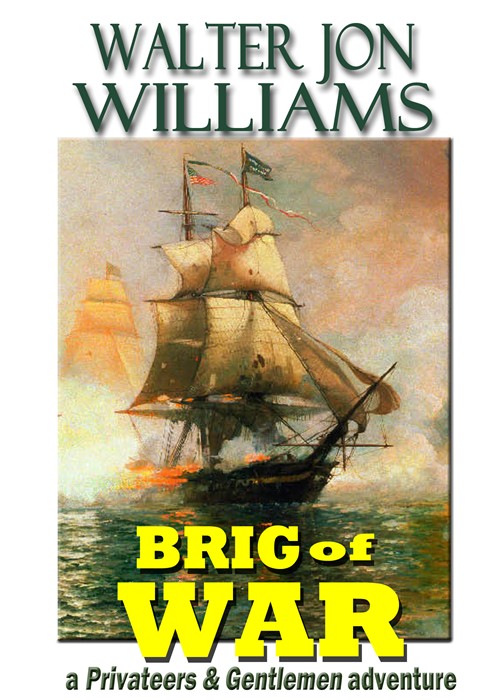 Brig of War, aka The Raider, is now live at Amazon, Barnes and Noble, and Smashwords.
Please download and enjoy. They are DRM-free, as are all my reissued ebooks.
It was fascinating revisiting this book, which I haven’t read since I last corrected the proofs. It was almost like discovering the writing of a stranger. I’m not that person any longer, and I’m not that writer, either.
Not that the book is inferior or anything. I think it’s quite good. It’s just that the me that wrote it is no longer me.
People familiar with my bibliography have already noted that this is my third Privateers & Gentlemen novel, and wondered why I’m starting the reissues halfway through the series. There are a number of reasons.
First, this one takes place in the War of 1812, and 2012 is the War of 1812 bicentennial. I wanted to steal some momentum from the many delirious War of 1812 celebrations going on across the country. *snicker*
Secondly, this is probably the book with the most going on. There’s sea combat, foreign intrigue, duels, sex, politics, and more, all in 140,000 words. So you’re really getting your money’s worth with this one.
Thirdly, this is the first in a trilogy about the same character, and the first two books in the series feature a pair of different protagonists. So if momentum is going to be got, it will be got with the trilogy.
And lastly, this was the book where my writing took a quantum leap for the better. Reading it now, I could practically spot the page. I had to go back and rewrite the earlier scenes in order to bring them up to the quality of the later bits.
Something really clicked in my head when writing this one, something that made me a far better writer. It was exciting to see that happen from the distance of thirty-odd years.
Privateers & Gentlemen, for those of you unfamiliar with the series, was my attempt to do for American naval history what CS Forester and Patrick O’Brian had done for the Royal Navy. I believe I may have been the first to attempt this since James Fenimore Cooper, who was a serving naval officer and who wrote as many sea adventures as he wrote Leatherstocking tales, for all that the former are now forgotten. (I read them. They’re pretty good, though with the same faults as Cooper’s other fiction.)
I did a vast amount of research for the series, and I believe that shows. (For the early U.S. Navy, I recommend Preble’s Boys by science fiction’s very own [and highly underrated] Fletcher Pratt, and The Naval War of 1812, by the 23-year-old Theodore Roosevelt.)
One of the conclusions I reached about the founders of the American naval tradition may be summed as follows: Holy Christ these people were fucking batshit crazy! Crazy even by the standards of Napoleonic-era warriors!
What these people did was sail around the oceans on incredibly complicated pieces of machinery running on wind and human muscle power, maneuver to within spitting distance of each other, and start firing off huge black-powder weapons in each other’s faces. And if that didn’t work, they’d get even closer and start hacking at each other with limb-lopping chunks of sharpened steel.
But okay, you say, that’s par for the course for Napoleonic-era warfare. Which is true. They all did that.
But the Americans were even more extreme. They were so combative that when they couldn’t find French or Tripolitans or British to kill, they’d start killing each other.
I suspect it’s the result of an inferiority complex vis-a-vis the Royal Navy. The Americans had to be better. They had to be better at warfare, of course, but they also had to be superior in everything else, including points of honor.
Stephen Decatur, the Navy’s earliest hero, died in a duel with a fellow captain over an incident that had taken place thirteen years earlier. Uriah Phillips Levy— who later abolished flogging, and who saved Jefferson’s home at Monticello— fought no less than six duels with brother officers. Richard Somers, accused of cowardice, proposed to fight six duels in one day, and actually fought three (being wounded twice) before his opponents reconsidered the matter of his courage. (Mon dieu, even d’Artagnan proposed to fight only three!)
Speak a careless word in the wardroom, and next morning it’s a cutlass through your gizzard. It’s the sort of thing that keeps you on your toes.
Yet these gamecocks went on to astonish the world and found the tradition that has given us the Navy of today. (And what tradition is that, you ask? Here ya go: Quality trumps quantity, so spare no expense to build the biggest, most heavily-armed, most technologically advanced ships on the seven seas. Because it’s better to fight the enemy over there than over here, make sure the ships have the range and reach to get wherever they need to go. Crew them with aggressive officers who are as ruthlessly competitive with each other as with the enemy [though fortunately they’re no longer expected to shoot at each other]).
Another element of naval reality of the period was that the officers of the United States Navy were an elite. The contemporary American military is full of elite soldiers of one sort of another; but for most of American history, elites were looked on with deep suspicion. Jefferson and the Democratic-Republicans viewed the very idea of a Navy as subversive of American values. We were a republic, not a monarchy: any elite military society could harbor anti-egalitarian sympathies and produce a king or dictator. Both Adams and Jefferson purged the service of officers deemed politically unreliable. So the American naval officers were viewed with deep suspicion by the very political leaders who sent them into combat.
It was a challenge to present the character of our early Navy— bloodthirsty, competitive, honor-mad— values that are not precisely in sympathy with those of our contemporary society. (Even in the contemporary military, I suspect it would be highly unusual for an officer to declare, “I seek glory”— in the Age of Sail, it would be a commonplace.)
My answer was Favian Markham, USN— a naval officer who is not entirely in sympathy with the values of his peers, but who is compelled for professional reasons to pretend that he is. He’s not an antihero— he’s brave, competent, and scientific— but he’s much more a man of the Enlightenment than a Romantic hero, and probably more cynical than is good for him.
I hope you like him.
Reader responses
Comments
Be the first to respond.