
May 14, 2015
The Broken Road
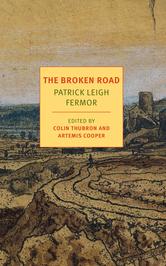 I’ve just finished The Broken Road, the long-delayed third volume of Patrick Leigh Fermor’s memoir of the walk across Europe that the 18-year-0ld Fermor took in 1933, just after Hitler took power in Germany.
I have mentioned the earlier volumes, A Time of Gifts and Between the Woods and the Water elsewhere, and added a little appreciation of my own on hearing of Fermor’s death, at the age of 96.
Though the books are a window into the personality of the bumptious young protagonist (as remembered by his mature, writerly self), and a fascinating description of a Europe that no longer exists, perhaps they are best appreciated as an exercise in pure literary style. The writing is so luxuriant and rich that maybe it’s best taken in small doses. Reading straight through would be like living for a month on a diet of raspberry Bavarian creme.
Fermor worked on the third volume for something like 35 years, and never completed it. The manuscript was edited after his death into its present form, and it’s still incomplete. When Fermor set off, in 1933, he was walking to Constantinople (the name he preferred to Istanbul), and while Fermor arrived, his manuscript does not— it leaves him walking down the Black Sea coast of Bulgaria, still forever on his journey. The editors then added extracts from his journal of a subsequent visit to the monasteries of Mt. Athos, in Greece— young Paddy’s journal is less highly wrought than the mature Fermor, but still worth reading.
The first two volumes featured young Paddy off on a journey, but Volume III finds him dawdling in Bulgaria and Romania. He’s in interesting company, and he always makes interesting observations, but there’s no sense that he or his narrative is actually going anywhere.
Still, it’s a lively world that he inhabits, and he’s always interested in the odd ethnic or linguistic group, and their histories. In his chapters on Bulgaria he discourses on Pomaks, Kutzovlachs, Arumans, Kizilbashi, Ladino-speaking Sephardim, Uniats, Paulicians, Bogomils, and Vlachs, as well as less exotic Greeks, Gypsies, and Turks. And these are as nothing compared to the subculture of Russian castrato taxi drivers he finds in Bucharest.
Fermor kept journals throughout his trip— and judging by the extracts on Mt. Athos, they were extremely detailed— and most of these were left behind in Moldova when Fermor marched off to World War II (where, naturally, he became a celebrated partisan fighter and decorated hero). But the journal on Bulgaria and Romania actually turned up, and maybe it inhibited him to some degree, reality proving a check on his unfettered literary imagination.
So I found The Broken Road a bit of a disappointment, but only in the sense that a 9.6 Olympic performance is disappointing in comparison to a 9.9. The third volume of the trilogy may be a bit of a letdown, but it’s still head and shoulders above anything else.
Reader responses
Comments
Be the first to respond.