
May 24, 2012
The S Word
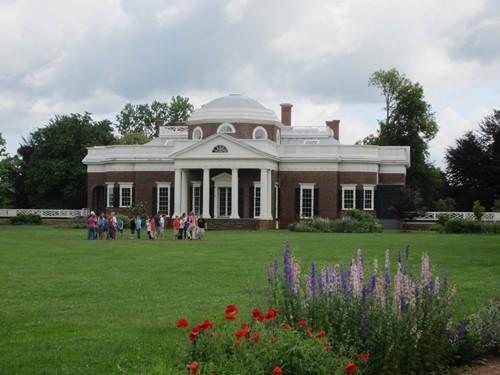 Here we see a view of one of the most famous back porches in America, that of Thomas Jefferson’s Monticello.
I spent a couple days traveling through Virginia before the Nebula Weekend, and one day— while Kathy was visiting a school chum in Charlottesville— I decided to go off in search of history.
I started with Monticello, and I tried to program my smartphone to give me directions. I thumbed in “Monticello Charlottesville Va.,” and was then asked, “Do you mean 1201 Monticello Lane, 1202 Monticello Lane, 1203 Monticello Lane,” etc. etc. No matter what I told the phone to find, it kept coming back to 1201 Monticello Lane, and all of the very many local streets named after Monticello.
Which Monticello, I screamed, do most people actually ask directions for? But no good. After turning the air in the car blue with my curses, I decided to depend on directions in a guidebook, which promptly got me lost. But I found the place eventually.
Monticello is ingeniously designed to look smaller than it actually is— as you can tell from the figures on the lawn, it’s actually a very large house, particularly for Virginia at the time, and it’s even larger than that, because the kitchens, storerooms, washrooms, etc, are cleverly placed underground. (Mr. Jefferson didn’t want anything spoiling his vistas.) But even so the place was overrun with family and visitors— Jefferson’s daughter and her eleven children lived there, for starters— and Mr. J was famously hospitable, with his expensive wines and his French-trained chef (a bondsman, brother of his mistress). The most famous statesmen of the land came to pay their respects, and because of the crowding ended up sleeping on the floor. (There was one proper bedroom reserved for James and Dolley Madison, however.)
Monticello shows you what a half-deranged dreamer Jefferson actually was. It’s as if Walt Disney had decided to level a mountain and build Sleeping Beauty’s Castle in the foothills of the Blue Ridge. Mr. J was a brilliant political theorist and a glorious rhetorician, but less successful when it actually came to running things like plantations, states, and nations. His estate was a monument to comfort, style, and deranged finances. His presidency is thought of as a success on account of the Louisiana Purchase— a no-brainer, really— but the Embargo Acts and other disasters are forgotten.
After Monticello I went to Ashlawn, the residence of James Monroe. The two places are in a kind of dialog with each other, made more interesting by the fact that Jefferson chose Monroe’s land and planted his orchard before Monroe even showed up. There is a vista from which Monroe could view Monticello looming over his life.
Ashlawn is much smaller, maybe eight rooms in all. (It’s hard to say for certain, because half the house burned down in the 19th Century and was reconstructed on a different plan.) Like Monticello, the place was often overcrowded with visitors, a situation made more complicated by the fact that Mrs. Monroe— who was 4’8″ and opinionated— really didn’t like people very much, and their elder daughter Eliza had been raised in a feminist school in revolutionary France, had received a man’s education, and was known as the “social disaster.” (A retiring Southron belle she was not.)
A few days later we went to Mt. Vernon, on the “mansion farm” of General Washington. The house seemed smaller than I expected, though comparison of photographs indicates that it may in fact be a little larger than Monticello. Since it was built rather higgledy-piggledy, perhaps it lacks Jefferson’s unifying vision and sense of proportion. There is only one grand room, used for formal dining. The view of the Potomac from the bluffs is wonderful.
All three presidential homes, by the way, owe their preservation not to the state, but to private individuals. Monticello was in a state of disrepair when it was purchased in the 1830s by Uriah Phillips Levy, the firebreathing commodore (and the first American Jewish naval officer) who succeeded in abolishing flogging in the Navy (and also fought six duels). He was a huge admirer of Jefferson, largely on account of Mr. J’s views on church-state separation, and the house remained in the Levy family until it was donated to the private trust that owns it now. Ashlawn was in private hands until the 1970s, when it was bequeathed to the College of William & Mary, who now operate it. And Mt Vernon was nearly ruined when it was purchased, in 1858, by the Mount Vernon Ladies’ Association of the Union, the formidably-titled association that still owns it.
What I found most intriguing on these visits was the subject that, a few decades ago, would not have been mentioned at all. Which is to say, slavery.
Of these places I’d visited only Monticello in the past, some thirty years ago, and other than a few oblique references to “the servants,” the subject did not arise. Yet Jefferson owned something like 250 human beings, including somewhere between two and five of his own children. Enormous numbers of slaves (as well as free laborers and artisans) were required to level the top of a mountain and build the house along with its outbuildings. 500o acres were tended by his bondspeople.
Since I last saw Monticello, archaeology has been performed on slave dwellings and workshops. The slave burial ground has been found. Jefferson’s DNA has been discovered in the descendants of Sally Hemings. The guides discuss Jefferson’s rather conflicted views on slavery. There is even a Slavery Tour— “History with an African-American slant” —which kicks off every hour. (Time considerations made it impossible for me to attend, unfortunately.) Yet there is still a strange remnant of that earlier reticence. The word “slave” is not encountered. Instead there is reference to “enslaved persons.” (While I’m glad they have achieved the personhood that so many tried to deny them, I regret extremely the clumsy locution.)
And in any case, the only black visitors to Monticello I saw were children in school groups. The descendants of slaves seem to have pretty well made up their minds about Mr. Jefferson.
When Jefferson died, his estate was $100 million in debt, in modern terms. The dreamer was very good at passing over any unpleasant thoughts, and as a result visited the unpleasantness on his extended family. He freed eleven slaves, all in the Hemings family, and the rest were sold to pay his debts.
Monroe had something like 30-50 slaves at Ashlawn, and like Jefferson was unable to make the system pay. (He earned his money as a lawyer, not a farmer.) He supported the efforts to repatriate black people to Africa and the foundation of Liberia, whose capital is named after him. The last of the Revolutionary presidents, he died on the Fourth of July, like Jefferson and Adams.
Washington was the richest man in the United States, had 500 slaves, and couldn’t make slavery work either. He freed all the slaves he owned personally, which was rather startling for someone born in a period when no one— by which I mean no one— thought slavery was bad. (Presumably slaves thought slavery was bad for them, but no one condemned the institution as a whole.) Yet Washington was the Man Who Saw Things Through, and had the moral (and physical) courage that Jefferson lacked.
(One reason why these gents couldn’t make slavery pay is that they were humane masters, as slaveholders went. They were always urging their overseers not to treat the slaves brutally, and Washington wouldn’t even sell a slave without the slave’s permission. Yet the way to make slavery truly profitable, as Cato the Elder wrote in De Agri Cultura, is to work the slaves to death and then replace them.)
At Mt. Vernon, there are now exhibits of slave life, slave work, and slave dwellings. (These were not present when Kathy last visited, a school trip in the fifth grade.) There are two monuments to the slaves, both set on the old slave burial ground (just a short walk from Washington’s tomb), and which form an picture of changing attitudes toward the institution. The oldest, from 1929, is dedicated to the “many faithful colored servants of the Washington family.” The more recent, dating from the 1980s, refers directly to “the Afro Americans who served as slaves.”
So some kind of dialog, however discreet, is now going on in the shadow of these monuments. Once history was all about Great Men and their deeds, but now we have somewhat enlarged horizons. Indeed we visit these places because of the Great Men who lived there, but now we have a clearer picture of the people who surrounded them— who labored in their fields, built and maintained their homes, cooked their food, raised their children, warmed their beds, and boiled their laundry.
Does this diminish the Great Men? Maybe a little. But it’s not as if Jefferson’s words are going to be scrubbed off his monument just because he was a flawed human being. In my view, he was diminished by being treated all those years as a marble statue, not as the complex individual that he in fact was.
And George Washington, at least, grew to understand that he was supported by a system that was immoral and unworkable, and unlike the others he acted on that knowledge.
Great Men, it must be admitted, are sometimes truly Great.
Reader responses
Comments
Be the first to respond.