
October 11, 2012
The Tern Schooner
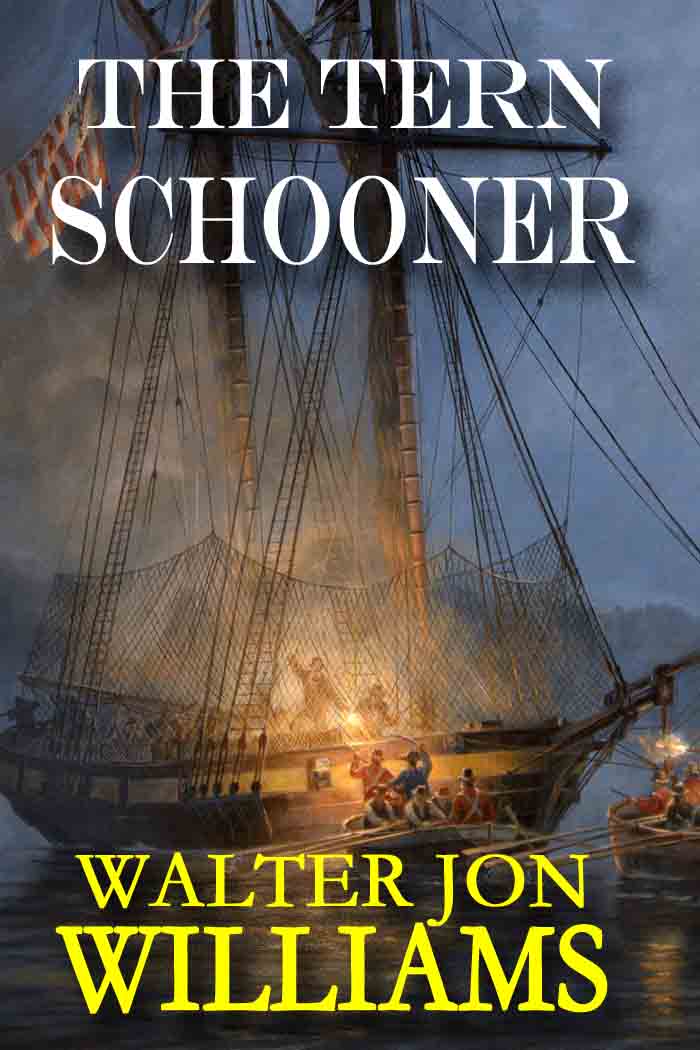 Behold! The Tern Schooner, the latest in the ebook reissues of my old sailing series, is now available via Amazon, Barnes & Noble, and Smashwords.
The book was originally published by Dell as The Yankee, in the same month and from the same publisher as The Yankee by Dana Fuller Ross. (Because Dell was just a fiasco in constant motion, that’s why, fascinating to watch if it wasn’t your career being made to walk the plank.)
I know I said I’d release Cat Island next, but once I got into the book, I realized that it involved characters and situations introduced in The Tern Schooner. So this one goes up now, and Cat Island in a week or two.
Unlike the other War of 1812 books, this one doesn’t deal with Favian Markham of the Navy, but rather his privateer cousin Gideon.
Gideon is an unusual action hero, in that he’s a convinced Puritan. But then what the hell, if Robert E. Howard could write about a Puritan swashbuckler, so could I!
I’ve long been interested in people who choose an inconvenient ideal to live by and then work it out in excruciating detail— the Brodainin warriors in Ambassador of Progress are another example— and so with Gideon, who spends a good deal of anguished time trying to work out whether or not he’s damned.
(Sounds like such fun, doesn’t it? But really, there’s enough action to keep the book from getting all theological.)
I’ve embroiled Gideon in the various happenings in the Gulf of Mexico, 1812-1814, of which there were a lot.
There was the naval war with England— at one point, American privateers had Jamaica completely under siege. There were the Baratarian pirates under Jean Laffite. There was the Creek War, which started out as a civil war among the Creek Indians, and then spread to their neighbors— and once that war got going, the British supported the Creeks with money and weapons so long as they continued to fight the United States. They even raised a battalion of Creeks, gave them uniforms and training, and used them in an invasion aimed at Mobile.
Why Mobile? Because it was a relatively easy march from Mobile to Baton Rouge, which could cut New Orleans off from the rest of the country.
I throw Gideon into the thick of all this, which means he has quite a lot to do besides brooding on his sins.
I based some of his character on that of Stonewall Jackson, who credited the Almighty with his victories and who preached a completely uncompromising brand of warfare.
But Gideon needed to be human, and he needed something to care about other than his precious soul, and so I introduced a comely widow, Maria-Anna de Marquez, who carries a pair of pistols, rules the table at poker, and is as ruthless at finance as Gideon is at combat. Gideon is a good deal softer at the end of the book than at the beginning.
There are also some chapters, some flashbacks, that catch the readers up on other members of the Markham family. They don’t advance the plot directly, but they provide a glimpse into the web of relationships in which Gideon was born, and highlight aspects of the history that Gideon doesn’t experience directly. (In short, I beg the readers’ patience.)
As for privateering itself, it was pretty much the salvation of the old republic. The U.S. Navy was small, and though it won some remarkable victories at sea, it couldn’t affect the larger course of the war. (This doesn’t count the battles of Erie and Champlain, which were decisive.) The British managed to blockade most of the American navy for most of the war, but they couldn’t lock up all the privateers. There were too many of them, and there were more all the time. Despite being blockaded for the entire war, Baltimore sent out more privateers than any other city, almost twice as many as the next two. (One privateer, aptly named Midas, slipped past the fleet bombarding Fort McHenry and seized the pay chest for the entire British force.)
(This is by way of pointing out that Gideon’s privateering exploits aren’t at all farfetched.)
By the end of the war it was nearly England, not just Jamaica, that was under siege. According to the Lord Provost, American privateers seized something like 800 British merchantmen in the first two years, and the totals were only getting worse.
(Plus the American navy kept getting bigger despite losses to the British. In late 1814, three American sloops of war were built near Boston in a mere 35 days. All were at sea by the end of the year.)
At the end, the British peace commissioners asked the advice of the Duke of Wellington. That worthy replied: “I confess that I think you have no right, from the state of the war, to demand any concession of territory from the Americans. You have not been able to carry it into the enemy territory, notwithstanding your undoubted military superiority, and you have not even cleared your own territory on the point of attack. You cannot on any principle of equality in negotiation claim a cession of territory excepting in exchange for other advantages which you have in your power. You can get no territory; indeed, the state of your military operations, however creditable, does not entitle you to demand any.” And that was before the catastrophe of New Orleans.
Ah, the catastrophe of New Orleans. That’s coming up in the next book, Cat Island.
Reader responses
Comments
Be the first to respond.