
December 28, 2013
True Tale of Christmas Terror!
You know, when I was small, there were two things that really scared me. One was the threat of nuclear war, and the other was . . . Christmas trees.
I’d like to think that the fear of nuclear war is self-explanatory. I was raised with air-raid drills and little public-service films, shown to us by our wonderful, caring teachers, that explained what to do if we were accidentally caught outside during a thermonuclear exchange.
Is it any wonder that so many of my generation turned into peaceniks? I had nightmares about nuclear war well into adulthood.
Perhaps the fear of Christmas trees requires a bit of explanation. I blame it on those public-service movies again— not only did I watch films in which mere teenagers somehow avoided nuclear incineration through common sense and forethought, I saw public-safety spots that documented the horrors of Christmas trees.
Specifically, Christmas tree fires. Now I realize that people back then used hazardous old tree lights, or put candles on trees so old and dry they’d turned into solid turpentine, but the message that my three-year-old mind took to heart was that at any time, and for no reason at all, Christmas trees could suddenly EXPLODE AND KILL EVERYONE IN THE HOUSE.
See! They’re still making movies like this! Films in which the beautiful tree, welcomed into the home, a symbol of light and warmth and treasure, became an INSTRUMENT OF TERROR AND FLAMING DEATH!
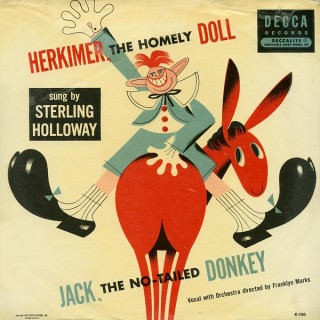 This even worked its way into children’s entertainment. Well do I remember a song called “Herkimer the Lonely Doll,” about a doll that nobody wants until it becomes a hero BY SAVING EVERYONE FROM A DEADLY CHRISTMAS TREE FIRE! I must have heard that song dozens of times on children’s television programs. I still vividly recall the distinctive voice of Sterling Holloway singing it. As a kid, I never found any Roger Corman film as scary as the animated version of that song.
What did those grownups think they were doing by making this stuff? I sweartagod . . .
My parents weren’t religious, but they did Christmas, as a way of bringing the family together and for the pleasure of seeing me made happy. And my memories of Christmas are almost entirely happy ones. However, I tended to view the trees brought into my boyhood home with a degree of suspicion. I wasn’t afraid of them exactly— I mean, they were just trees, and I wasn’t scared of trees— but I was wary. I wasn’t entirely convinced that the trees set up in the corner of the living room might not be some kind of vegetable stalker, just waiting to lull us to sleep before IMMOLATING US IN A FIENDISH ALL-CONSUMING BLAZE!
I remember lying in my bed at night, staring through the door and down the hallway and trying to decide if the glimmer of light in the hall mirror were the passing headlights of a car, or the INITIAL SPARK THAT WOULD TURN MY HOME INTO A FIERY HOLOCAUST.
I made plans. I’d wake my parents if I could, but if that weren’t possible . . . remember that the films assured me that a tree could turn into a blazing deadly torch in MERE SECONDS, so I might be cut off . . . anyway, I’d have to clamber up the bookcase to the windows, open the window, somehow release the storm window, and jump out into the snow, through which I would then run to alert a neighbor.
(These plans were as nothing compared to my elaborate scheme for surviving nuclear war. I was quite the planner. After all, the public-service spots assured me that anything was survivable through common sense and forethought, even having a Soviet ICBM dropped on my head.)
I eventually outgrew my tree terrors, and I’ve got a tree in the house right now which I have not viewed with any degree of trepidation. My fear of nuclear war won’t entirely fade as long as nations are run by fallible human beings, but it has receded in to the background, while the foreground is occupied by thoughts of age, illness, and death.
And while I’m still a planner, my plans for avoiding these last remain somewhat tenuous.
What were you scared of when you were little? And are you still?
Reader responses
Comments
Be the first to respond.