
April 18, 2014
Dinosaurs
 For the last couple days I’ve been watching a new water well being drilled on my property, so I’ve had to hang around and throw circuit breakers, and otherwise make sure the house didn’t burn down. The result is that my self-publishing efforts got a boost, mainly because there was nothing else to do but work. Two stories in two days! Rah!
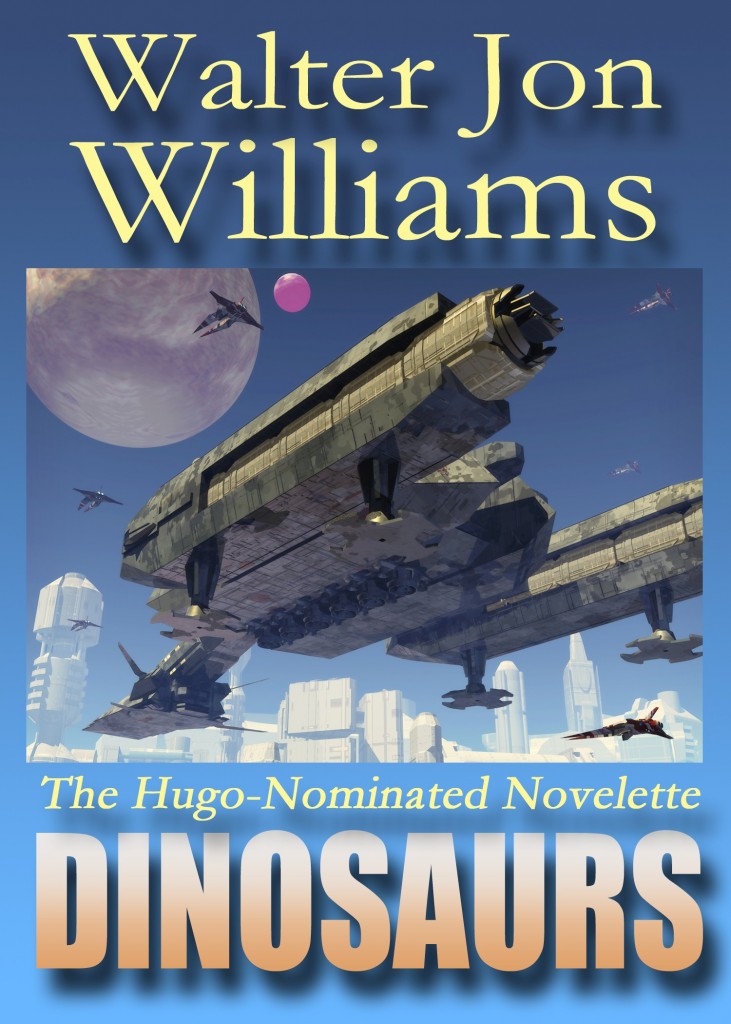
I’m pleased to announce that the house now has sweet water for the first time in, well, ever, and that my Hugo-nominated novelette “Dinosaurs” is now available via Amazon, Barnes & Noble, Kobo, Baen, and Smashwords, and it will be available in other forums shortly. It’s only $0.99. Spend like the wind!
I don’t remember anything about the genesis of this story, except that it shares a fear of senility that is visible in a lot of my stories from this period. Zimmerman in Knight Moves, Roon in Hardwired, Telamon in “Surfacing,” and Drill in “Dinosaurs,” all suffer from a kind of senescence, a retreat into a pampered mental infancy in which every desire is fulfilled and every problem is taken care of, often by a surrogate parent. (In “Dinosaurs,” the surrogate is even named Surrogate.)
This may be autobiographical, albeit at some remove. At one point in my life I watched an aneurism turn my father from a vital, active man into a semi-invalid with no particular purpose in life, and whose needs were taken care of with perfect efficiency by his devoted spouse. He was far from senile, but he was wandering through existence without quite knowing who he was anymore, and that situation produced in me more than its fair share of terror.
I was not afraid of mere senility, but of senile systems: governmental or societal systems that had lost their reason for being, but which still wielded power without quite remembering what it was for. In “Dinosaurs,” the entire human race has grown so vast and over-specialized that any actual reason for its existence seems to have been lost.
The story was first sold to L. Ron Hubbard, of all people. He had just announced a science fiction magazine, and was paying top rates. I figured if such venerable figures as Jack Williamson, Fred Pohl, and Roger Zelazny could be a part of Elron’s various publishing enterprises, then so could I.
The check arrived on the very day the news announced that Hubbard had died. “Better cash the check quick,” I said to myself, and did. Somewhat to my surprise, the check cleared.
Unfortunately that meant that Hubbard’s publishing company still had the rights to the story, even though the magazine was canceled shortly after Hubbard’s death. So it was two or three years later that “Dinosaurs” actually appeared in Asimov’s, was nominated for a Hugo, and lost to Ursula K. LeGuin.
“Dinosaurs” has been one of my most reprinted stories, and is probably my most popular story in Eastern Europe. After all, if they don’t know what it is to be conquered by a vast, powerful, alien, and senile political system, who does?
Reader responses
Comments
Be the first to respond.