
April 24, 2014
Happy 450th, Mr Shakespeare
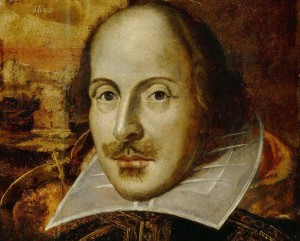 Today is the day we traditionally celebrate the birth of “Gulielmus filius Johannes Shakspere,” as he was referred to in his baptismal records. It may not be his actual birthday, but what the hell: Let’s celebrate anyway!
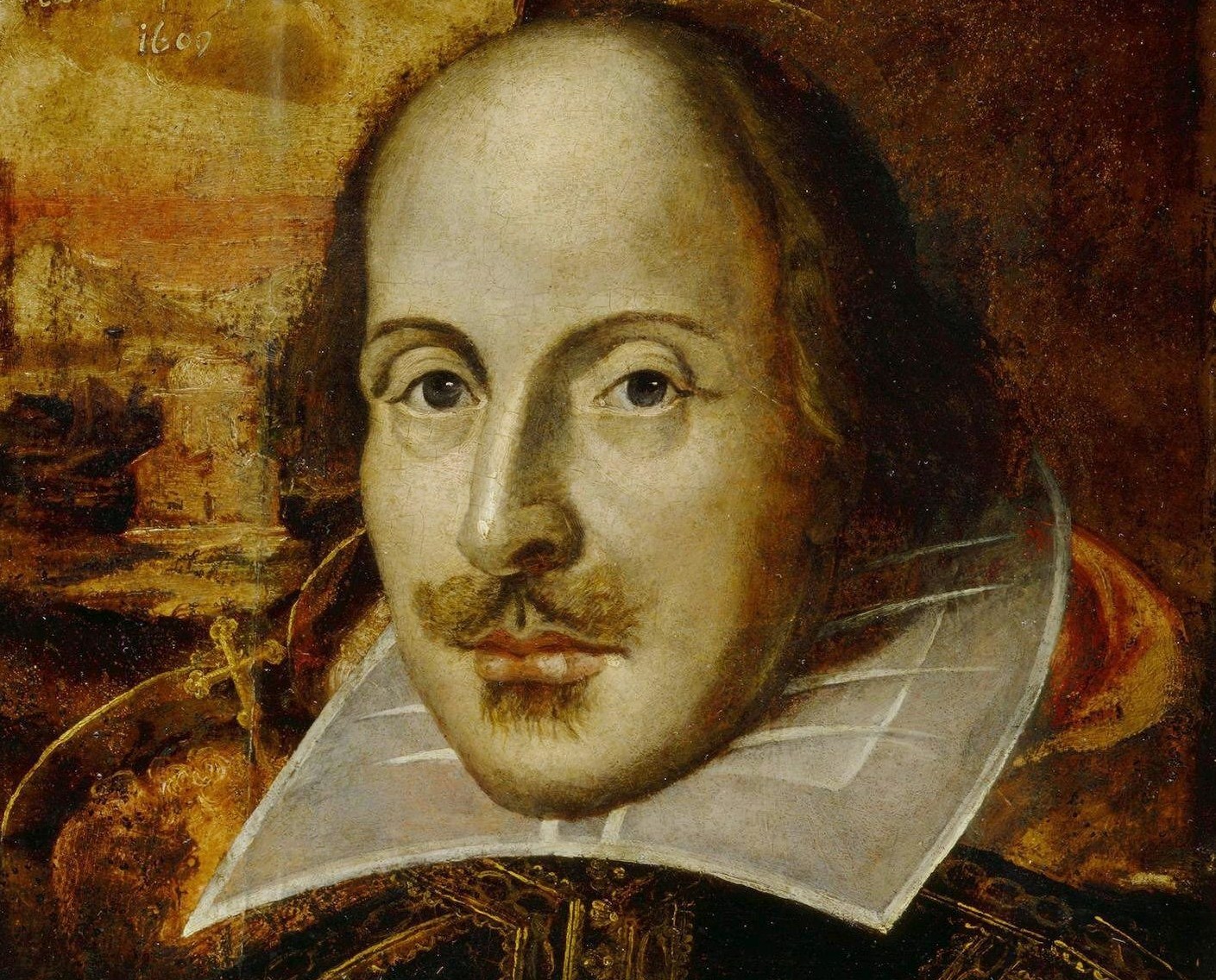
There’s a kind of bad literary scholarship that we might refer to as “spot-the-influence,” in which the critic observes in the text a reference to, say, The Golden Bowl, and then pronounces, “This book was written under the influence of Henry James,” or “This book is a response to Henry James,” or, worse, “This book is a sad-ass imitation of the Master, Henry James.”
Anyone who’s actually written a long piece of fiction knows that the matter of literary influence is a good deal more complicated than that. For my own part, my day-to-day writing is primarily influenced by whoever I was reading on that particular day. If I reference Henry James, it’s because James was on the menu du jour, not because I have in mind some elaborate pastiche of The Aspern Papers.
(This matter of transient literary influence is the reason why, when I’m doing my final draft, I try to make sure I’m reading a really, really good stylist. Who is often but not always Nabokov. [I now look forward to a critic drawing out all the elaborate parallels between Angel Station and Pnin.])
(And now that I think of it, didn’t Nabokov already parody that type of critic in Pale Fire?)
Long-term influence is another matter. There are a select few writers who stay with you, and there are other writers who influence you because they helped form fiction itself. It could be argued that every writer today is influenced by Henry James whether he’s read James or not.
But if you’re looking for the primary influence on my work, you need look no further than the gent at the upper right. I started devouring Shakespeare in grade school, and much of my undergraduate career was devoted to the Elizabethans in general and Shakespeare in particular. I’m at home in the Elizabethan idiom, and I believe I’ve mentioned that parts of one novel were translated from Elizabethan into modern English. I’ve read Shakespeare, I’ve written about Shakespeare, and I’ve acted Shakespeare. (I was freakin’ Prince Hal, I’ll have you know.)
Shakespeare will teach you how character will illuminate action, and action illuminate character. He’ll teach you how to dramatize characters’ thoughts, how to break your story into acts so that everything doesn’t happen at once, how to relieve the heavy drama with comedy, how to pace the story, how to create vivid minor characters, how to focus a really big story on just a few characters so that it’s manageable. How to work philosophy and introspection into narrative, how to make prose poetic and how to make poetry carry story, how to give wonderful human moments to villains so that they’re not one-dimensional. How to use neologisms (Shakespeare coined 1700 words, apparently). How to introduce fantastic elements into narrative. How to load backstory into narrative. How character and action and narrative are basically all the same thing. (And he’ll teach you how to create a list like this and make it interesting.)
Hell, how to do historical fiction. Because I think he invented all that with the history plays.
I steal from Shakepeare all the time. I rip off his plots. I make free use of his characters. (“This scene is all, like, Othello meets Richard II on the Seacoast of Bohemia.”) Sometimes I’ll paraphrase his best lines. And of course, like every other English speaker, I use those 1700 neologisms and those distinctive phrases.
And like Shakespeare, I try to just get on with it. (“It’s a business, write your quota, you can fix it later.” “Introspection is for guys without deadlines.” “If you don’t put the words on paper, your genius won’t be visible to anyone, least of all you.” [In fact I think those are all quotes from Coriolanus, no?] )
Whenever I’m in some kind of jam, the tune to “Brush Up Your Shakespeare” begins to buzz in the back of my head.
So here’s to young Gulielmus. May you live another 450 years!
Reader responses
Comments
Be the first to respond.